
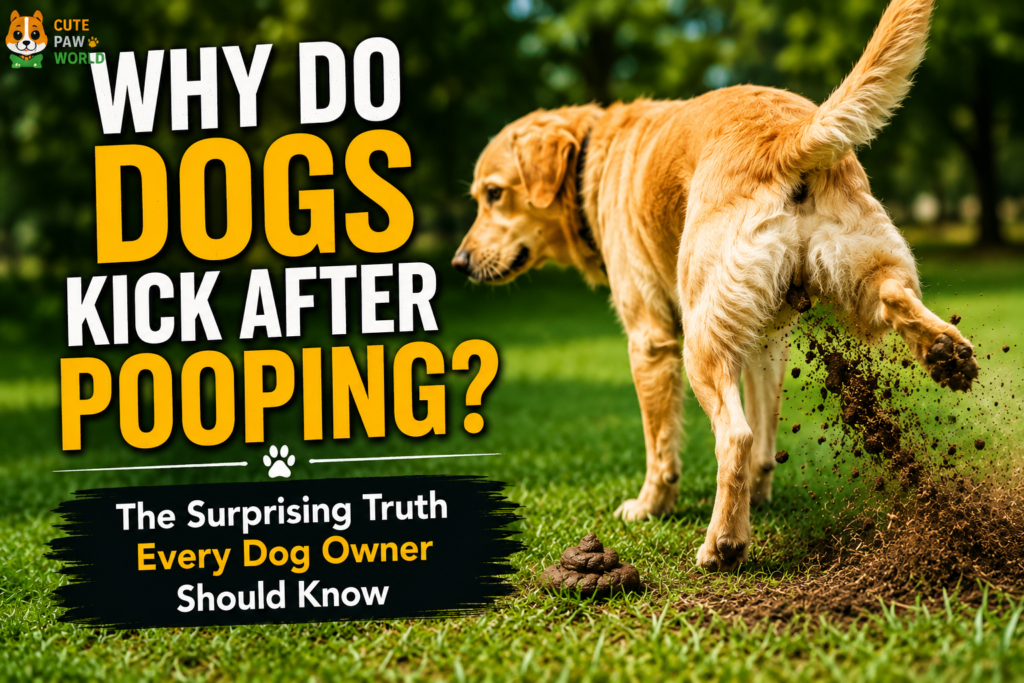
Why Does Your Dog Kick After Pooping?
You take your dog outside, they sniff around, finally choose the perfect spot, do their business—and then suddenly kick the grass, dirt, or sand backward like they have just won a championship.
If you have ever wondered, “Why Do Dogs Kick After Pooping?”, you are definitely not alone.
At first glance, it can look like your dog is trying to cover the poop. Others assume the dog is simply wiping its paws or celebrating the fact that the bathroom trip is over.
But the real explanation is much more interesting.
That dramatic kicking motion is generally connected to canine communication and scent marking. Dogs experience the world through smell in a way humans simply cannot. What looks like a few seconds of chaotic scratching to us may actually be part of a sophisticated communication system.
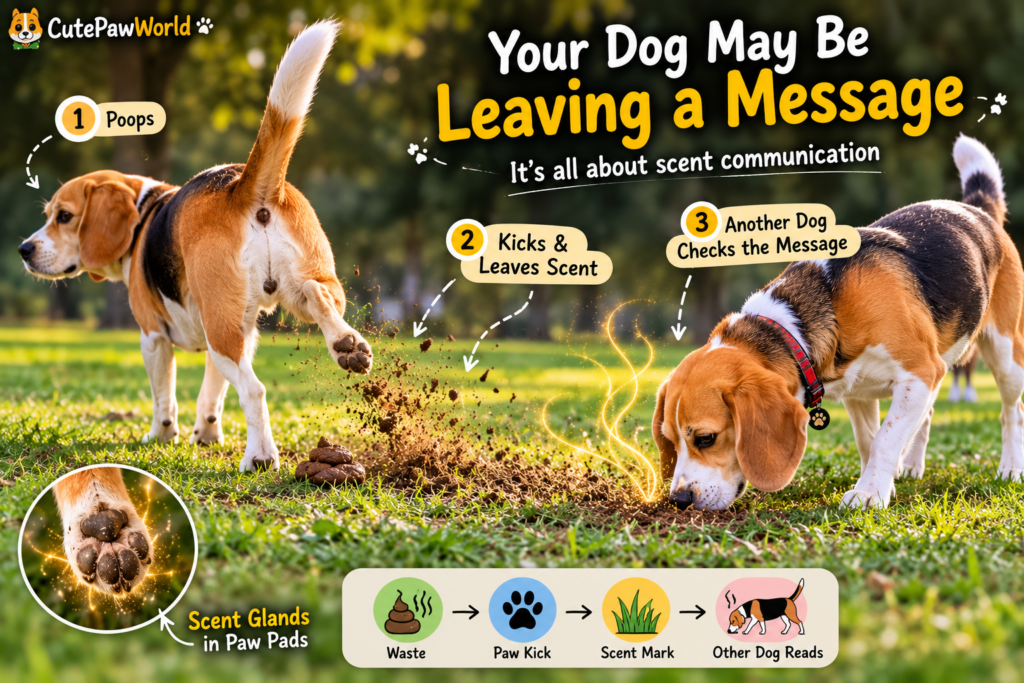
Veterinary and canine-behavior sources explain that dogs can leave both scent signals and visible marks when they scratch the ground after eliminating. Their paw pads contain scent-producing structures, and the scratching action can help distribute those odors while also disturbing the ground.
So, Why Do Dogs Kick After Pooping?
The short answer is:
They may be leaving a message.
And that message isn’t necessarily as simple as “This is my territory.”
Let’s break down what is really happening.
Is Your Dog Actually Trying to Cover Its Poop?
This is probably the first question most owners ask.
Cats commonly scratch around their waste as part of covering it. Dogs, however, generally aren’t performing the same behavior when they kick their back legs after pooping.
When a dog kicks backward, it usually isn’t trying to bury the stool.
Instead, the behavior can create two different kinds of signals:
- A chemical signal through scent
- A visual signal through scratched or disturbed ground
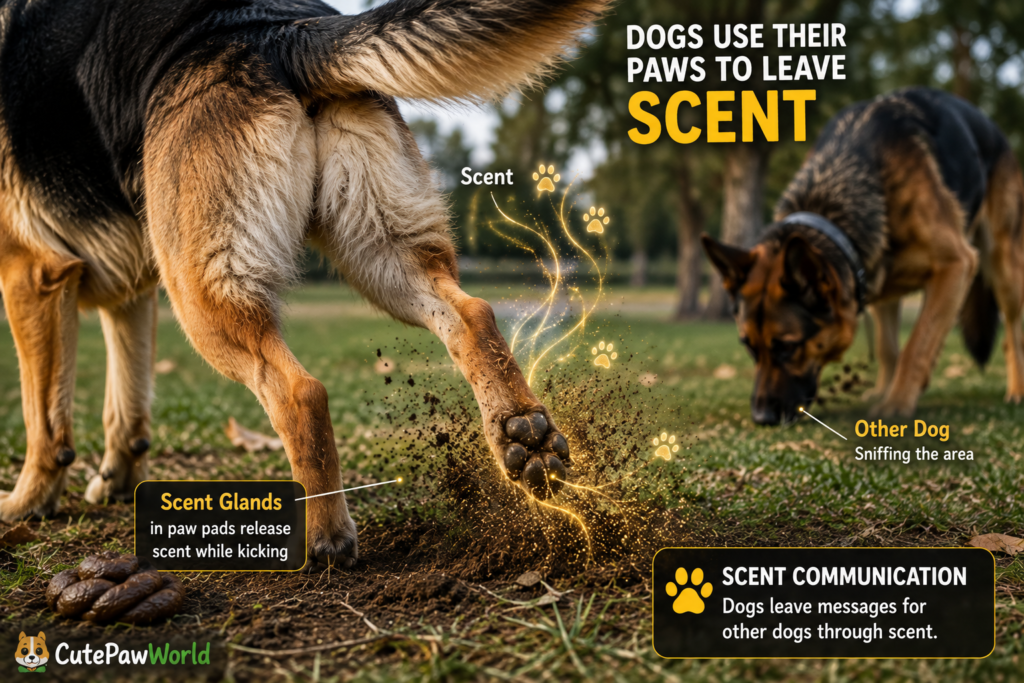
VCA explains that dogs have scent glands in their paw pads and between their toes. When they kick backward, they can leave scent signals as well as visible evidence that they were there.
Think of it like leaving a message on a public noticeboard.
Humans might leave a note.
Dogs leave smells.
That difference is important when understanding Why Do Dogs Kick After Pooping?
1. Scent Is a Huge Part of the Explanation
Dogs don’t simply smell things for fun.
Scent is one of their most important methods of gathering information and communicating.
According to the Merck Veterinary Manual, canine social communication includes scents, pheromones, body language, vocalizations, and touch. Scent marking is an important way dogs communicate with other dogs.
That means your dog’s bathroom routine can be much more complicated than it appears.
Your dog may smell another animal’s urine or feces and gather information about who has recently passed through an area.
Then your dog eliminates and may kick the ground afterward.
To a human observer:
“Why is my dog destroying the grass?”
To another dog:
“Someone has been here.”
That is one reason Why Do Dogs Kick After Pooping can be better understood as a communication question rather than a cleanliness question.
2. Your Dog’s Paws Can Help Spread Its Scent
Here’s the part many owners don’t know.
The underside of a dog’s paws isn’t simply a collection of cushions designed for walking.
Dogs have scent-producing structures associated with their paws. When they scrape their hind feet against the ground, they can potentially distribute scent around the area.
The scratching also leaves a physical mark.
So your dog may essentially be combining:
Poop + scent + scratching + visual disturbance
That’s a surprisingly sophisticated combination.
VCA describes the behavior as leaving both visual and scent signals, while the AKC notes that dogs may kick after eliminating as part of scent communication.
3. Is It Really About Territory?
This is where things get more interesting.
For years, people have commonly described this behavior as simple territorial marking.
And there is some truth to that interpretation—but it can be too simplistic.
Dogs use scent to communicate, but we shouldn’t assume every kick means:
“This territory belongs to me.”
The exact information being communicated through scent is difficult for humans to decode.
VCA notes that scientists are still working to understand exactly what information the scent signals communicate.
So rather than saying your dog is definitely declaring ownership, it is more accurate to say that the dog may be advertising its presence or leaving information for other dogs.
That’s an important distinction.
4. Your Dog May Be Saying “I Was Here”
Imagine walking through a neighborhood and seeing a small sign:
“John visited this place.”
You immediately know someone has been there.
Dogs have their own version of this.
When a dog eliminates and then scratches the surrounding ground, it may leave a combination of odor and visual evidence.
Another dog coming through later can investigate the smell.
That’s why the question Why Do Dogs Kick After Pooping doesn’t have to be answered only with “territory.”
It may be more accurate to think:
“This is a canine social message.”
The message could communicate presence, identity, or information about the animal that passed through.
Exactly what another dog interprets from the scent is something humans can’t completely translate.
5. Why Do Some Dogs Kick Much More Than Others?
Now you may be wondering:
“If this is normal, why does my dog do it every single time?”
And why does another dog barely do it?
Individual dogs simply have different habits.
Some dogs kick dramatically after almost every bathroom break.
Others may do it occasionally.
Some barely scratch the ground at all.
Breed, personality, environment, excitement, social surroundings, and individual habits can all influence behavior.
You may notice stronger kicking when your dog is walking in a place where many other dogs have recently been.
That makes sense because dogs are constantly processing smells around them.
A busy dog park, neighborhood sidewalk, or popular walking trail can become a giant collection of scent information.
Your dog isn’t just going for a walk.
Your dog may be reading the neighborhood.
6. Why Dogs Kick More at Dog Parks
Watch your dog at a quiet location and compare that behavior with a busy dog park.
You may notice a difference.
At a dog park, there are many competing smells.
Dogs have urinated.
Dogs have pooped.
Dogs have walked through the grass.
Dogs have rubbed against surfaces.
Dogs have left scent from their paws and bodies.
The environment is full of information.
If your dog starts sniffing intensely and then kicks aggressively after eliminating, the environment may be encouraging more scent-related behavior.
The AKC specifically notes that kicking can become more intense around other dogs.
This is another clue when trying to understand Why Do Dogs Kick After Pooping?
7. The Poop Itself Can Carry a Scent Message
Here’s another fascinating piece of the puzzle.
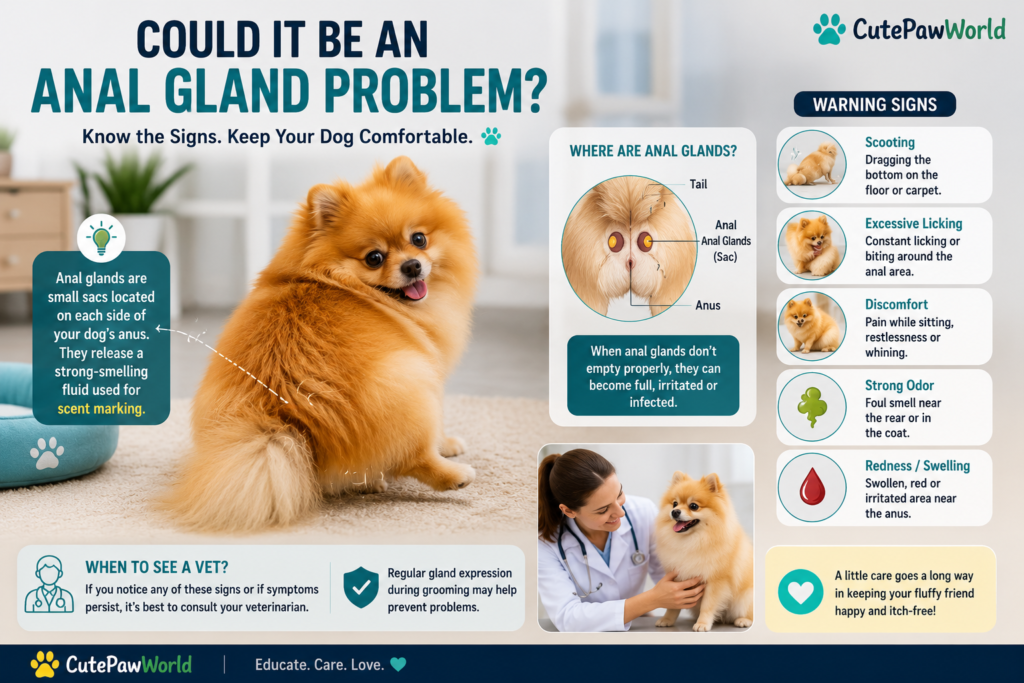
Dogs have anal sacs, commonly called anal glands, located on either side of the anus.
These sacs contain a strong-smelling fluid.
VCA explains that anal sac secretions contribute to the distinctive odor associated with feces and can function as chemical signals.
That means the poop itself isn’t necessarily just waste from a dog’s perspective.
It can also carry chemical information.
This helps explain why dogs are so interested in sniffing one another’s poop.
To humans, it’s disgusting.
To dogs, it’s information.
A dog may be able to gather clues from another dog’s scent that humans simply cannot detect.
8. The Combination Is More Important Than One Single Signal
This is probably the most useful way to think about the behavior.
Your dog isn’t necessarily communicating with only one signal.
It may be combining several:
| Dog Behavior | Possible Function |
|---|---|
| Urinating | Scent communication |
| Defecating | Leaves odor information |
| Sniffing | Collects information |
| Scratching ground | Visual + scent signal |
| Paw contact | May distribute paw scent |
| Body language | Additional social information |
This is why Why Do Dogs Kick After Pooping is more interesting than it first appears.
Your dog’s bathroom routine can involve several layers of communication.
9. Does Kicking Mean Your Dog Is Being Dominant?
Not necessarily.
This is another common misconception.
You will sometimes hear people say:
“My dog kicks because he’s showing dominance.”
That explanation is often too broad.
Canine behavior is rarely that simple.
Dogs communicate through scent, body posture, facial expressions, vocalizations and many other signals.
A dog kicking after pooping doesn’t automatically mean it wants to dominate every dog nearby.
It may simply be performing a normal scent-related behavior.
So don’t label your dog as “aggressive” or “dominant” just because it scratches the ground after using the bathroom.
Look at the entire context.
10. Why Does My Dog Kick Grass but Not Concrete?
This can be especially interesting.
Grass and soil are easy to scratch.
Concrete isn’t.
If your dog normally eliminates on grass, you may see a dramatic backward kick afterward.
On a hard surface, the same movement may be less obvious.
The behavior itself may still occur, but the environment changes what you can see.
VCA notes that dogs may perform this behavior on different surfaces, although repeated kicking on rough surfaces can potentially cause paw-pad problems.
So the surface can influence how dramatic the behavior looks.
When Should You Be Concerned?
The good news is that for most dogs, occasional kicking after pooping is simply a normal behavior.
You don’t automatically need to stop it.
In fact, if your dog kicks a few times on grass and happily continues walking, there may be nothing wrong at all.
But there are situations where you should pay closer attention.
11. Normal Kicking vs. Problematic Kicking
Here’s a simple comparison:
| Normal Behavior | Potential Concern |
|---|---|
| Brief kicking after elimination | Repeated or obsessive scratching |
| Dog remains relaxed | Dog appears anxious or distressed |
| Healthy paw pads | Cracked or bleeding paw pads |
| Happens mainly outdoors | Suddenly starts indoors |
| Dog walks away normally | Dog repeatedly returns to scratch |
| No other symptoms | Scooting, licking, pain or discharge |
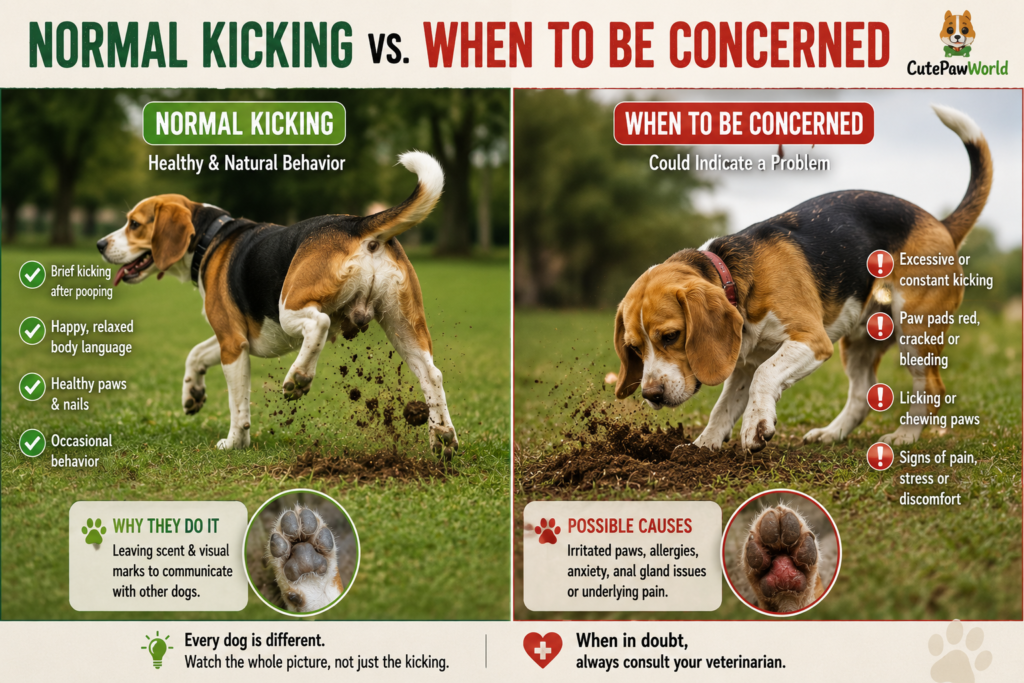
The behavior becomes more important when it changes suddenly or is accompanied by other symptoms.
12. Watch Your Dog’s Paw Pads
If your dog kicks aggressively every day, inspect the paws occasionally.
Look for:
- Cracks
- Bleeding
- Redness
- Broken nails
- Swelling
- Sensitivity
- Excessive licking
The AKC and VCA both note that vigorous or repeated scratching can occasionally damage paw pads or nails.
A few kicks on soft grass are very different from repeatedly scraping paws against rough concrete.
If your dog seems painful when walking, that’s no longer just a quirky behavior.
13. What If Your Dog Suddenly Starts Kicking Much More?
A sudden behavioral change deserves attention.
Ask yourself:
What changed recently?
Maybe:
- A new dog moved nearby.
- You moved to a new home.
- You changed your walking route.
- A new puppy arrived.
- There are more dogs in your neighborhood.
- Your dog experienced a stressful event.
- Your normal routine changed.
The AKC notes that increased kicking can sometimes occur alongside environmental or emotional changes.
The key is not to panic.
Instead, look for patterns.
14. Could Anxiety Be Involved?
Sometimes behavior changes can be associated with stress or anxiety.
But don’t automatically diagnose anxiety just because your dog kicks.
Look at the complete picture.
Does your dog also:
- Pant excessively?
- Tremble?
- Hide?
- Pace?
- Avoid certain places?
- Become unusually vocal?
- Show changes in appetite?
- Become unusually clingy?
If multiple unusual behaviors appear together, it is worth discussing them with a veterinarian or qualified behavior professional.
Merck Veterinary Manual notes that fear and anxiety can influence elimination-related behavior, although medical causes should also be considered when elimination habits change.
15. What About Anal Gland Problems?
This is where owners sometimes confuse two completely different behaviors.
A dog kicking after pooping is not automatically experiencing an anal gland problem.
But if your dog is also scooting its bottom across the floor, repeatedly licking the area, showing discomfort, or producing an unusual strong odor, you should pay attention.
Anal sac problems can cause discomfort, inflammation, impaction, or infection.
VCA lists signs such as scooting, licking and difficulty or discomfort around bowel movements as reasons to seek veterinary attention.
So remember:
Kicking the grass ≠ automatically an anal gland problem.
The surrounding symptoms matter.
16. When Should You Call the Vet?
Contact your veterinarian if you notice:
- Blood around the anus
- Significant swelling
- Pus or unusual discharge
- Severe pain
- Difficulty passing stool
- Persistent scooting
- Excessive licking
- Sudden major behavior changes
- Injured or bleeding paw pads
Don’t try to diagnose anal gland disease from kicking alone.
A veterinarian can examine your dog and determine whether there is a medical problem.
17. Should You Stop Your Dog From Kicking?
If your dog is healthy and simply performs a few kicks on grass, you usually don’t need to stop the behavior.
It’s part of normal canine behavior.
However, you may want to redirect it if:
- Your dog damages your lawn.
- Your dog scratches indoor carpets.
- Your dog damages furniture.
- Your dog hurts its paws.
- The behavior becomes excessive.
VCA suggests redirecting the dog into another behavior after elimination, such as sitting, heeling, or offering a high-five, using rewards to build a new routine.
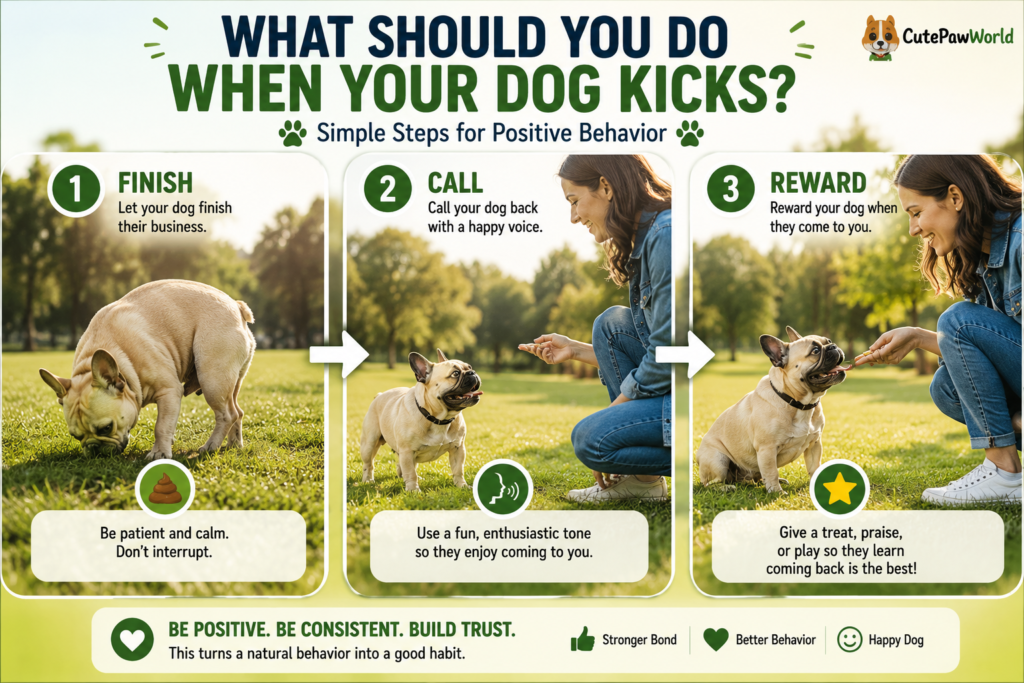
18. A Simple Way to Redirect the Behavior
Don’t yell.
Don’t punish.
And don’t make your dog afraid of going to the bathroom.
Instead, create a predictable post-potty routine.
Try this:
Step 1: Let your dog finish
Don’t interrupt the actual elimination.
Step 2: Wait for the kick
Give your dog a moment.
Step 3: Call your dog
Use a cheerful cue such as:
“Come!”
Step 4: Reward
Give praise or a small appropriate treat.
Step 5: Keep walking
Over time, your dog may learn that finishing the bathroom routine means coming back to you and continuing the walk.
The goal isn’t to punish natural behavior.
The goal is to teach an alternative behavior.
19. Never Punish Your Dog for Normal Elimination Behavior
This is important. Why Do Dogs Kick After Pooping
Your dog shouldn’t associate going to the bathroom with fear or punishment.
Merck Veterinary Manual emphasizes reward-based approaches for appropriate elimination behavior and warns that punishment can be counterproductive.
So if your dog kicks grass after pooping, don’t scream:
“STOP!”
Instead, ask yourself whether the behavior is actually causing a problem.
If not, you may simply want to let your dog be a dog.
20. Why Dogs Don’t Always Behave the Way Humans Expect
One of the biggest lessons from understanding Why Do Dogs Kick After Pooping is that dogs don’t experience the world exactly as we do.
We see grass.
They smell hundreds of things.
We see poop.
They detect chemical information.
We see scratching.
They may be communicating.
This is why many strange dog behaviors become less strange once we look at them from the dog’s sensory world rather than the human world.
21. Your Dog’s Nose Changes Everything
Dogs have an extraordinary sense of smell.
That means an ordinary walk for you may be a completely different experience for your dog.
Imagine walking through your neighborhood while reading dozens of messages left by people on the sidewalk.
That would make a five-minute walk extremely information-heavy.
For dogs, scent can work in a somewhat comparable way.
A tree, fire hydrant, patch of grass, or sidewalk may contain information about animals that passed through earlier.
Merck describes scent marking as a central feature of canine social communication.
So when your dog stops repeatedly to sniff during a walk, don’t assume they’re wasting time.
They’re investigating.
22. The “Post-Poop Kick” May Be Part of a Bigger Routine
Here’s a fresh way to look at the behavior.
Don’t isolate the kick.
Watch the entire sequence.
You may see:
Sniff → circle → eliminate → sniff again → kick → walk away
That sequence can tell you much more than the kicking alone.
Your dog’s behavior before and after elimination gives you context.
For example, a relaxed dog that kicks twice and happily continues walking is very different from a dog that repeatedly scratches, looks nervous, licks its paws, or seems uncomfortable.
Context is everything.
23. What About Puppies?
Puppies can also display interesting elimination-related behaviors as they learn about their environment.
A puppy may sniff excessively, investigate other dogs’ scents, or experiment with scratching.
Don’t expect every puppy to behave exactly the same.
The most important thing during puppyhood is positive training and consistent routines.
If your puppy eliminates outdoors and then kicks the grass, there’s generally no reason to punish the behavior simply because it looks strange.
24. Male Dogs vs. Female Dogs: Is There a Difference?
You may have heard that this behavior is mainly something male dogs do.
That’s not accurate.
Both male and female dogs can participate in scent-related communication.
Merck notes that scent marking behaviors can occur in both sexes, although some marking patterns are more common in particular groups of dogs.
So if your female dog dramatically kicks the grass after pooping, there’s nothing inherently unusual about that.
25. Does Breed Matter?
Breed can influence many aspects of canine behavior, but you shouldn’t assume that only certain breeds kick after pooping.
Individual personality and environment can be just as important.
A confident Labrador may kick.
A tiny Chihuahua may kick.
A German Shepherd may kick.
A mixed-breed rescue dog may kick.
Or none of them may do it.
The behavior is not exclusive to one breed.
26. A Quick Myth vs. Fact Guide
| Myth | Fact |
|---|---|
| Dogs kick to hide poop | Usually, kicking is associated with scent/visual communication |
| Every kicking dog is dominant | Kicking doesn’t automatically mean dominance |
| It’s always an anal gland problem | Normal kicking alone doesn’t indicate anal gland disease |
| You must stop the behavior | Healthy outdoor kicking usually doesn’t need correction |
| Dogs don’t communicate through poop | Elimination can carry chemical information |
| Kicking is always a sign of anxiety | Normal kicking can occur without anxiety |
| Dogs only kick because they are excited | The behavior is strongly associated with scent communication |
27. The Most Interesting Answer to “Why Do Dogs Kick After Pooping?”
If we had to reduce everything to one idea, it would be this:
Your dog may be leaving information behind.
The poop provides odor.
The paws can contribute scent.
The scratching creates a visible disturbance.
Together, these may function as a canine communication event.
That’s much more fascinating than simply saying:
“Your dog is kicking because dogs kick.”
Related Dog Behavior
Learn more about dog habits, body language, and everyday behavior on CutePawWorld. If you enjoyed Why Do Dogs Kick After Pooping, explore our other simple dog-care guides. Understanding Why Do Dogs Kick After Pooping can help you better understand your dog’s natural behavior.
- 15 Powerful Signs Your Puppy Loves You (Don’t Ignore These Hidden Clues)
- 25 Cutest Dog Breeds That Stay Adorable Forever (Avoid These Common Mistakes Before Choosing One)
- 10 Best Slow Feeder Dog Bowls for Fast Eaters (2026): Stop Dangerous Gulping & Improve Digestion
- First 30 Days With a New Puppy: The Ultimate Survival Guide to Avoid Common Mistakes & Raise a Happy Dog
- Best Dog Food for Sensitive Stomach: Vet-Approved Picks That Actually Work in 2026!
- Puppy Biting Everything? 10 Proven Ways to Stop Destructive Chewing
- Brain Training for Dogs Review 2026: Honest Results, Powerful Benefits & Hidden Downsides
28. What Should Dog Owners Actually Do?
For most owners, the answer is surprisingly simple.
If your dog is healthy:
Let them do it.
If they scratch your lawn:
Redirect them after they finish.
If they damage their paws:
Reduce access to rough surfaces and speak with your veterinarian if there is injury.
If the behavior suddenly changes:
Look for environmental or behavioral changes.
If there are signs of pain:
Get veterinary advice.
If there are anal-gland symptoms:
Have your veterinarian examine the dog.
This balanced approach avoids turning a normal behavior into a medical emergency.
Final Thoughts: Your Dog Isn’t Being Weird—They’re Communicating
So, Why Do Dogs Kick After Pooping? What looks like random kicking may actually be part of a much older and more sophisticated canine communication system.
If you have ever wondered Why Do Dogs Kick After Pooping, the answer is closely connected to scent, marking, and communication with other dogs.
Dogs use scent constantly. They investigate the smells left by other animals and leave their own chemical information behind. This helps explain Why Do Dogs Kick After Pooping and why the behavior can happen immediately after elimination.
When your dog scratches the ground with its back paws, it may be adding another layer to the scent message already left behind. In other words, Why Do Dogs Kick After Pooping isn’t simply about making a mess on your lawn.
The next time your dog finishes pooping, turns around, and starts throwing grass everywhere, don’t immediately think:
“What on earth are you doing?”
Instead, think:
“You’re leaving a message, aren’t you?”
Understanding Why Do Dogs Kick After Pooping can help you see this funny habit from your dog’s perspective rather than judging it by human behavior.
For a healthy dog, a few energetic kicks on soft grass are usually nothing to worry about. That’s another important part of understanding Why Do Dogs Kick After Pooping: normal kicking is generally very different from behavior accompanied by pain or other symptoms.
The important thing is to watch the whole dog, not one behavior in isolation.
If the kicking is sudden, excessive, painful, or accompanied by scooting, licking, discharge, bleeding, or other unusual symptoms, that’s when a veterinary check becomes worthwhile. Knowing Why Do Dogs Kick After Pooping also means knowing when the behavior looks different from your dog’s normal routine.
Ultimately, Why Do Dogs Kick After Pooping isn’t just a funny dog fact you can share with friends.
It teaches us something bigger about canine behavior: dogs are constantly communicating through scent, body language, sounds, and physical marks.
Once you understand Why Do Dogs Kick After Pooping, that dramatic little grass-kicking routine suddenly becomes much more fascinating.
And the next time your dog performs its post-potty kicking ritual, remember Why Do Dogs Kick After Pooping—they may simply be leaving behind a message for the next dog that comes along.
Dogs are constantly communicating—we just have to learn how to read the messages.
🐾 Quick Takeaway
Why Do Dogs Kick After Pooping?
✔ They may be spreading scent from their paws.
✔ They may be leaving a visual mark on the ground.
✔ The behavior can be part of canine social communication.
✔ It does not necessarily mean your dog is trying to cover its poop.
✔ It doesn’t automatically mean your dog is dominant or anxious.
✔ Normal outdoor kicking usually doesn’t need to be stopped.
✔ Excessive kicking, injured paws, scooting, pain, or discharge deserve attention.
🐶 What Does Your Dog Do?
Does your dog perform a tiny two-kick routine after pooping—or completely destroy the grass like a lawn mower?
Tell us in the comments.
And if this article finally answered Why Do Dogs Kick After Pooping, share it with another dog owner who has watched their pup perform this hilarious post-potty ritual.
For more fascinating dog behavior facts, health tips, breed guides, and practical advice, keep exploring CutePawWorld.
Research Sources
The behavior and veterinary explanations in this article were cross-checked against the American Kennel Club, VCA Animal Hospitals, and Merck Veterinary Manual.
Further reading: American Kennel Club — Why Does My Dog Kick the Grass After Pooping? · VCA — Why Do Dogs Kick Grass After Relieving Themselves? · Merck Veterinary Manual — Social Behavior of Dogs
Conclusion: Why Do Dogs Kick After Pooping?
If you’ve ever wondered Why Do Dogs Kick After Pooping, the behavior is usually more fascinating than it first appears. What looks like random scratching can be connected to scent communication, marking, and the way dogs interact with their environment.
Understanding Why Do Dogs Kick After Pooping helps us look at this behavior from a dog’s perspective. Dogs experience the world largely through scent, so a simple bathroom break can become an opportunity to leave information behind.
The question Why Do Dogs Kick After Pooping doesn’t have just one simple explanation. Paw scent, disturbed soil, fecal odors, and social communication may all play a role.
For many healthy dogs, Why Do Dogs Kick After Pooping is simply part of their normal outdoor routine. A few energetic kicks after eliminating are generally nothing to worry about.
However, understanding Why Do Dogs Kick After Pooping also means recognizing when something looks unusual. Excessive scratching, injured paws, pain, persistent licking, scooting, bleeding, or discharge should not be ignored.
If your dog suddenly changes its normal behavior, the answer to Why Do Dogs Kick After Pooping may require looking at the bigger picture. Changes in environment, routine, stress, or physical discomfort can sometimes affect canine behavior.
The next time someone asks you Why Do Dogs Kick After Pooping, you can explain that dogs may be communicating through scent and physical marks rather than simply trying to make a mess.
Learning Why Do Dogs Kick After Pooping can also make everyday walks more interesting. Your dog isn’t just walking from one place to another—it may be constantly collecting and leaving scent information.
Once you understand Why Do Dogs Kick After Pooping, that funny grass-kicking routine can look completely different. Instead of seeing meaningless behavior, you can recognize a natural part of canine communication.
So, Why Do Dogs Kick After Pooping? In many cases, they may be leaving behind a scent or visual message for other dogs to investigate.
The fascinating part of Why Do Dogs Kick After Pooping is that dogs communicate in ways humans cannot easily see or smell. Their noses and scent-based behaviors give them access to information that is largely invisible to us.
Ultimately, Why Do Dogs Kick After Pooping is a reminder that even the strangest-looking dog habits can have a purpose.
If you enjoyed learning Why Do Dogs Kick After Pooping, share this article with another dog owner who has watched their pup perform this hilarious post-potty ritual.
And the next time your dog kicks grass after doing its business, remember Why Do Dogs Kick After Pooping—your dog may simply be communicating in its own unique way.
Dogs don’t use words to tell us everything. Sometimes, their paws, noses, and everyday habits tell the story.