
Introduction-
Bringing home a puppy looks simple in photos: one tiny face, a soft bed, a few toys, and endless cuddles. Then the puppy arrives—and suddenly you have accidents on the floor, nighttime whining, sharp little teeth, chewed furniture, a confusing feeding schedule, and a dog who seems to have unlimited energy.
The truth is that the First 30 Days With a New Puppy are not really about creating a perfectly trained dog. They are about creating a safe, predictable environment where your puppy can learn that your home is a good place to live.
During these first few weeks, your puppy is learning hundreds of things at once. They are discovering where to sleep, where to eliminate, which sounds are normal, which people are safe, how humans communicate, how to settle down, and what happens when they make a mistake.
That is why the First 30 Days With a New Puppy can feel exhausting even when everything is going well.
This guide takes a practical approach. Instead of promising a magically obedient puppy in 30 days, we will focus on the foundations that make the next several months dramatically easier.
You will learn how to prepare your home, establish a realistic routine, begin house training, introduce crate or confinement training, handle biting, socialize safely, manage sleep, plan veterinary care, prevent common mistakes, and build a relationship based on trust.
Important: This guide provides general educational information. Your puppy’s vaccination schedule, diet, parasite prevention, medical care, and exercise needs should be individualized with a veterinarian.
Why the First 30 Days With a New Puppy Matter So Much
The first month is a transition period—not a test.
Your puppy may have recently left its mother and littermates and suddenly entered a completely different environment. New smells, floors, sounds, people, food, routines, and sleeping arrangements can be overwhelming.
A common mistake is expecting the puppy to immediately understand household rules.
They don’t.
Instead, think of the first month as an orientation program.
Your puppy needs to learn:
- Where food and water are available
- Where to sleep
- Where to toilet
- Which objects are appropriate to chew
- How to respond to their name
- How to settle down
- How to interact with people
- That being briefly alone is safe
- That handling paws, ears, mouth, and body can be normal
- That good behavior gets rewarded
The First 30 Days With a New Puppy should therefore prioritize consistency over perfection.
A puppy that has one accident today has not failed training. A puppy that bites your sleeve does not automatically have an aggression problem. A puppy that cries during the first night is not necessarily becoming spoiled.
The better question is:
What is my puppy trying to learn from this situation?
That change in perspective can make puppy parenting much less stressful.
Day 1: Don’t Overwhelm Your Puppy
The first day should be surprisingly boring.
You may want to introduce your puppy to every family member, show them every room, take dozens of photographs, invite friends over, and start training immediately.
Resist the temptation.
Your puppy has just experienced a major life change.
Instead, create a small, calm area where your puppy can rest, eat, drink, and explore safely.
Your first-day priorities
- Take the puppy to the designated toilet area.
- Offer fresh water.
- Provide the food recommended by the breeder, rescue organization, or veterinarian.
- Show the puppy their sleeping area.
- Allow quiet exploration.
- Keep interactions gentle.
- Begin observing their normal behavior.
Don’t worry about teaching ten commands on day one.
The first lesson is simply:
“This place is safe.”
That is one of the most important lessons in the entire First 30 Days With a New Puppy.
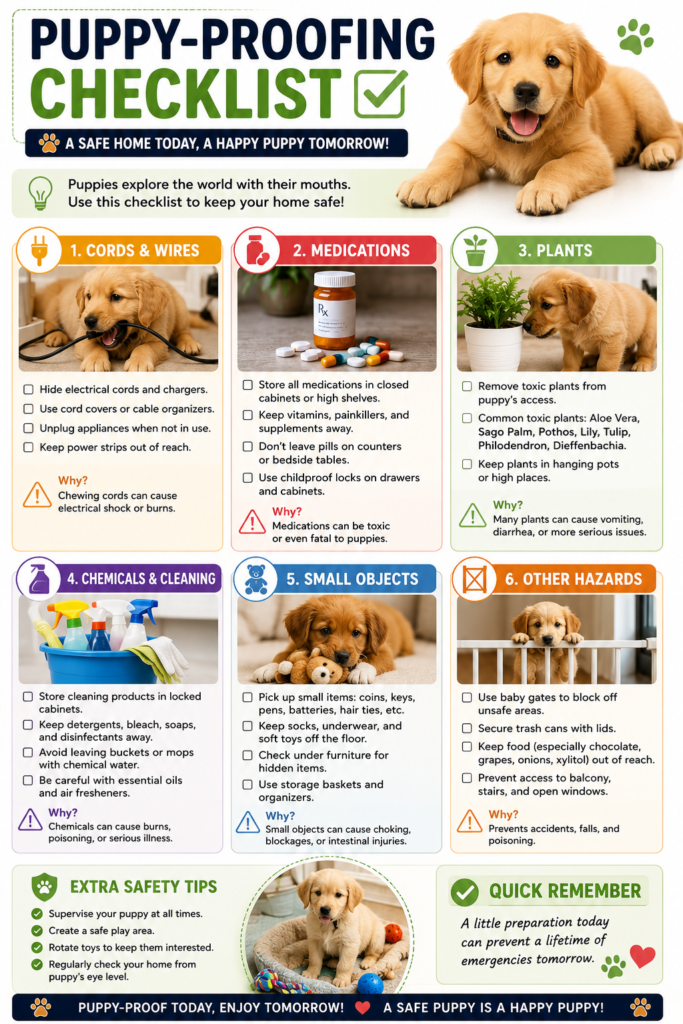
Puppy-Proof Your Home Before Problems Happen
Puppies investigate the world with their mouths.
That means your house can suddenly become a giant collection of potential chew toys.
Electrical cords, medications, small objects, toxic plants, cleaning chemicals, food, trash, and accessible household items can create serious risks. The ASPCA specifically recommends securing medications and checking the home for potentially poisonous plants and other hazards before bringing a young pet home.
Use the “puppy-eye view”
Get down near floor level and look around.
Ask:
- What can the puppy chew?
- What can the puppy swallow?
- What can fall over?
- What can be pulled down?
- What can the puppy climb onto?
- Where could the puppy become trapped?
This is one of the easiest ways to make the First 30 Days With a New Puppy safer.
Create a puppy zone
You don’t necessarily need to give the puppy access to the entire house.
A puppy-proofed room, pen, or gated section can make supervision easier while the puppy learns the rules.
This also prevents a common beginner mistake: giving a puppy too much freedom too quickly.
The First Veterinary Visit
A veterinary appointment should be one of your early priorities.
Bring any records supplied by the breeder, shelter, rescue organization, or previous owner. Your veterinarian can review vaccination history, discuss parasite prevention, assess overall health, and create an appropriate preventive-care plan.
Vaccination is not a one-size-fits-all process. AAHA’s guidelines emphasize individualized vaccination plans based on factors such as age, history, lifestyle, and exposure risk. Their updated guidance also identifies distemper, adenovirus, parvovirus, leptospirosis, and rabies among core vaccination considerations, with rabies administered according to applicable laws.
Your puppy’s veterinarian should determine the exact schedule.
Ask your veterinarian about:
- Vaccinations
- Deworming
- Flea and tick prevention
- Heartworm prevention where relevant
- Diet
- Weight and growth
- Microchipping
- Safe exercise
- Socialization
- Dental care
- Spay/neuter timing
- Emergency warning signs
Do not copy another dog’s medication or vaccination schedule simply because the puppy looks similar.
House Training: The Realistic Approach
House training is probably the biggest challenge during the First 30 Days With a New Puppy.
And the biggest mistake is waiting for the puppy to tell you.
Your job is to create opportunities for success before accidents happen.
The RSPCA recommends taking puppies out at key times such as after waking, after meals, after play or exercise, before bedtime, around exciting events, and frequently throughout the day. It also recommends immediate rewards after successful toileting.
A simple potty-training cycle
Wake up → potty → eat → potty → play → nap → potty → repeat
The exact schedule will depend on the puppy’s age, health, environment, and individual ability.
Watch for signals
Your puppy may:
- Sniff the floor
- Circle
- Wander away
- Become restless
- Suddenly stop playing
- Move toward a previous accident area
When you see these behaviors, act quickly.
Take the puppy to the correct location and reward the desired behavior immediately.
Don’t punish accidents
Punishment after an accident often teaches the wrong lesson.
Your puppy may learn that eliminating in front of you is dangerous rather than learning where you actually want them to go.
Instead:
Prevent → supervise → redirect → reward.
That formula is far more useful during the First 30 Days With a New Puppy.
Feeding: Build a Routine, Not a Guessing Game
Puppy nutrition depends on age, size, breed, growth rate, health, and the food being used.
Rather than changing foods repeatedly, begin with the food your puppy was already eating if appropriate, then discuss any transition with your veterinarian.
Most puppies need more frequent meals than adult dogs. AKC guidance notes that many puppies eat three meals per day, although individual feeding plans vary.
Establish consistent meal times
For example:
| Time | Activity |
|---|---|
| Morning | Wake + potty + breakfast |
| Midday | Potty + lunch |
| Afternoon | Play + nap |
| Evening | Dinner + potty |
| Night | Calm routine + final potty |
The goal isn’t to create a military schedule.
The goal is predictability.
Predictability helps you anticipate when your puppy will need to eat, eliminate, play, and sleep.
Sleep: The Secret Ingredient Most New Owners Miss
Here is a surprising truth:
A tired puppy isn’t always a well-behaved puppy.
Sometimes an exhausted puppy becomes a tiny furry chaos machine.
Puppies can sleep for many hours a day. AKC notes that puppies commonly sleep around 18–20 hours daily, although individual needs vary. Adequate sleep supports growth and development, while overstimulation can contribute to undesirable behavior.
So if your puppy suddenly becomes:
- Extremely bitey
- Wildly energetic
- Unable to focus
- Zooming around the house
- Barking constantly
- Irritable
don’t automatically assume they need more exercise.
They may need a nap.
Create a nap routine
After a period of eating, exploring, playing, or training, provide an opportunity for quiet rest.
A crate, pen, bed, or puppy-safe room can become a predictable resting location.
This is one of the most underrated lessons of the First 30 Days With a New Puppy.
Crate Training Without Making the Crate Scary
A crate should never be used as punishment.
Instead, make it a predictable safe place.
Start with the door open.
Place appropriate treats or food inside.
Allow the puppy to investigate.
Reward calm behavior.
Gradually increase the amount of time the puppy spends there while you remain nearby.
Avoid this mistake
Don’t suddenly put a puppy into a crate for several hours on the first day and expect them to love it.
That’s like meeting someone for five minutes and then asking them to live in your bedroom.
Build the association gradually.
The AVSAB also recommends appropriate confinement training because crates and pens can provide safe spaces for rest and help puppies become comfortable with confinement.
The Puppy Biting Problem
Almost every new puppy owner eventually asks:
“Why does my adorable puppy keep biting me?”
Because puppies explore, play, communicate, and interact with their environment using their mouths.
The goal isn’t to expect zero mouthing immediately.
Instead, teach the puppy what is appropriate to bite.
Keep legal chew options nearby
When the puppy grabs:
- Your hand
- Trouser legs
- Shoes
- Furniture
- Remote controls
redirect them toward an appropriate toy.
The moment they engage with the toy, reward the choice.
You are teaching:
“This is what you can chew.”
rather than simply:
“Don’t do that.”
That distinction becomes extremely important throughout the First 30 Days With a New Puppy.
Start Training With the Puppy’s Name
You don’t need an advanced obedience program during week one.
Start with something incredibly simple:
Name → look at you → reward.
Say your puppy’s name once.
When they look toward you, reward.
Repeat several times during short sessions.
Soon, the puppy begins learning that their name predicts something positive.
From there, you can gradually introduce:
- Come
- Sit
- Leave it
- Drop it
- Touch
- Wait
Keep sessions short.
Several tiny sessions are usually easier for a young puppy than one long training session.
Days 8–15: Build a Predictable World
By the second week, your puppy may appear more confident.
This is when some owners make a major mistake.
They assume:
“He’s settled now, so I can give him the whole house.”
Not necessarily.
Instead, slowly expand freedom as your puppy demonstrates reliability.
Think of access to the house as something your puppy earns through good habits.
A useful progression
Small safe area → supervised room → larger supervised area → limited unsupervised freedom
This prevents many preventable accidents.
Socialization: More Than “Meet Everyone”
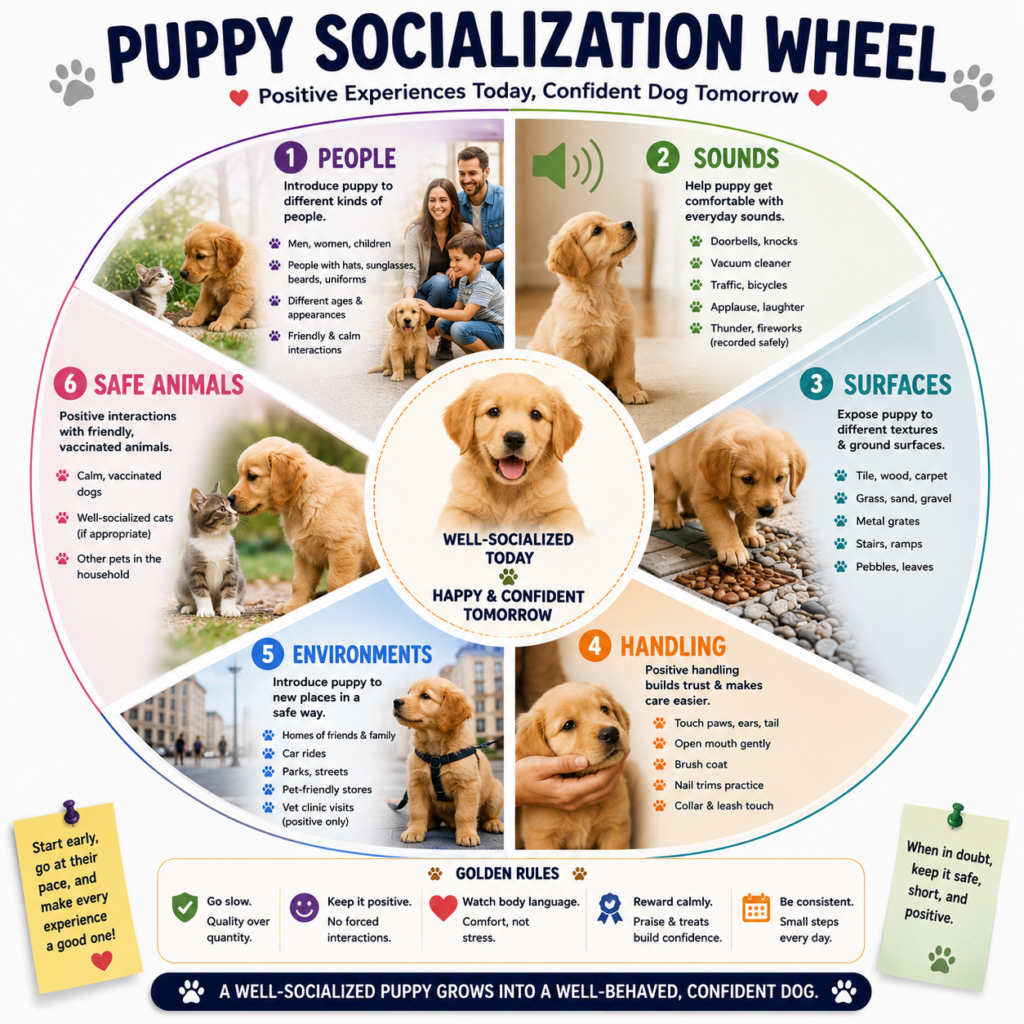
One of the most important insights for the First 30 Days With a New Puppy is that socialization isn’t simply forcing your puppy to meet as many people and dogs as possible.
AVSAB explains that early socialization should expose puppies to a variety of people, animals, environments, and stimuli safely and without causing excessive fear or overstimulation. It also states that the first three months are particularly important for social development.
That means quality matters more than quantity.
Socialization can include:
- Different floor surfaces
- Household sounds
- Car rides
- Hats and umbrellas
- Doorbells
- Vacuum cleaners
- Different people
- Calm, appropriate dogs
- Different rooms
- Gentle handling
- New objects
- Outdoor sights and sounds
Your puppy doesn’t need to interact with everything.
Sometimes simply observing something calmly is excellent socialization.
Vaccines and Socialization: Don’t Choose an Extreme
New owners sometimes hear two conflicting messages:
“Don’t take your puppy anywhere until all vaccines are finished.”
and:
“Socialize your puppy immediately.”
The answer is not to ignore either concern.
Instead, ask your veterinarian about safe socialization opportunities based on local disease risk and your puppy’s vaccination status.
AVSAB supports carefully managed puppy socialization before full vaccination, while emphasizing appropriate preventive care and safe environments.
That could mean controlled puppy classes, carrying your puppy outdoors, meeting healthy vaccinated dogs you know, experiencing different household environments, or sitting somewhere safe and simply watching the world.
Avoid high-risk environments such as heavily trafficked dog areas when your veterinarian advises against them.
Your Puppy Is Now Learning Patterns
During the second half of the month, start looking for patterns.
When does your puppy usually:
- Wake up?
- Need to potty?
- Get hungry?
- Become energetic?
- Become tired?
- Start biting?
- Settle naturally?
These patterns are valuable information.
Instead of constantly reacting to your puppy, you can begin predicting what comes next.
That is the real turning point of the First 30 Days With a New Puppy.
Create a Daily Puppy Routine
A realistic routine might look something like this:
| Time | Routine |
|---|---|
| 7:00 AM | Wake + potty |
| 7:15 AM | Breakfast |
| 7:30 AM | Potty |
| 7:45 AM | Short training/play |
| 8:30 AM | Nap |
| 10:00 AM | Potty + exploration |
| 10:30 AM | Short training |
| 11:00 AM | Rest |
| 12:00 PM | Meal if age-appropriate + potty |
| 1:00 PM | Nap |
| 3:00 PM | Play + training |
| 4:00 PM | Rest |
| 6:00 PM | Dinner if age-appropriate + potty |
| 7:00 PM | Calm family time |
| 8:30 PM | Final play/potty |
| Bedtime | Sleep |
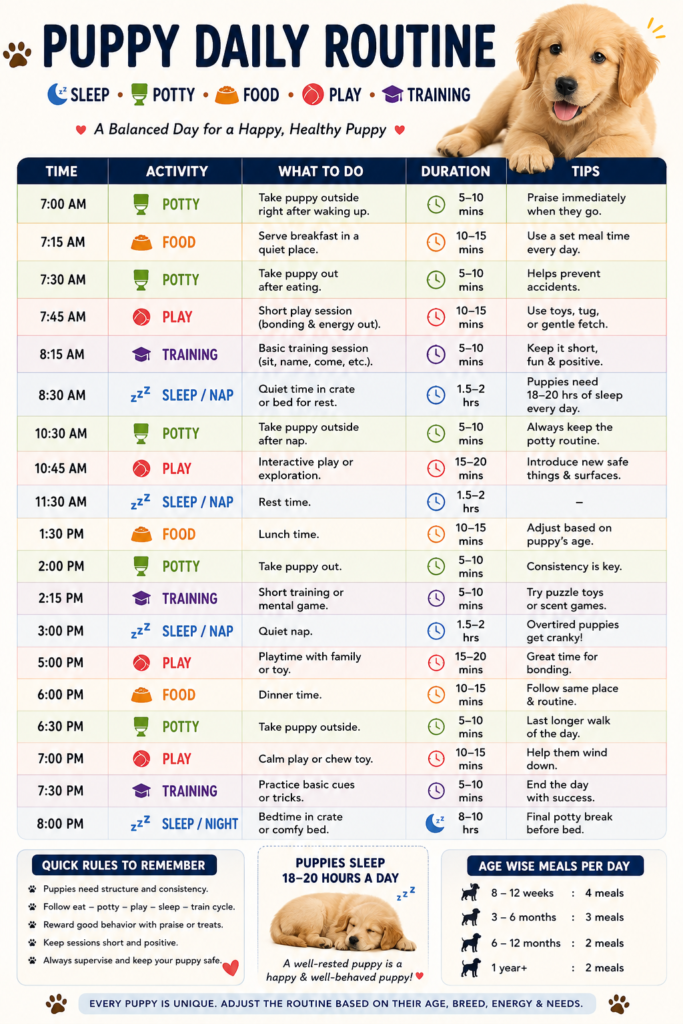
This is a template, not a rule.
Your puppy’s age, breed, health, household schedule, and veterinarian’s advice should determine the actual routine.
Exercise: Don’t Try to Exhaust Your Puppy
A common belief is:
“If I tire my puppy out enough, they’ll behave.”
That can backfire.
Young puppies need movement, play, exploration, and mental stimulation, but strenuous exercise should be appropriate for their developmental stage.
AKC recommends several shorter play and exercise sessions rather than relying on long, strenuous activity, noting that growth and exercise needs differ among breeds.
Better than exhausting your puppy:
- Short sniffing sessions
- Gentle play
- Basic training
- Food puzzles
- Safe exploration
- Chewing
- Brief walks when appropriate
- Socialization
- Rest
The goal isn’t exhaustion.
The goal is balanced stimulation followed by recovery.
Alone-Time Training Starts Now
Another mistake is spending every second with the puppy and then suddenly leaving for several hours.
Instead, teach independence gradually.
Give your puppy a safe area with an appropriate chew or enrichment activity.
Step away briefly.
Return before the puppy becomes highly distressed.
Gradually increase the duration as your puppy becomes comfortable.
AKC provides age-based guidelines showing that very young puppies generally have limited capacity to remain alone and need frequent bathroom opportunities.
The lesson is:
Being alone is temporary, predictable, and safe.
This is an important part of the First 30 Days With a New Puppy because independence is easier to build gradually than repair after a major problem develops.
Handling Exercises You Should Start Early
Imagine trying to clip your dog’s nails for the first time when they are 60 pounds.
That’s why gentle handling should begin early.
For a few seconds at a time, calmly touch:
- Paws
- Ears
- Tail
- Shoulders
- Chest
- Mouth area
- Collar
- Legs
Pair handling with treats.
Never force a frightened puppy through a handling session.
The objective is to teach:
“Human hands touching me can predict good things.”
This can make future grooming and veterinary care easier.
Common Mistakes to Avoid
The First 30 Days With a New Puppy become much easier when you know what not to do.
Mistake 1: Giving Too Much Freedom
A puppy who has access to the entire house may quickly develop habits you don’t want.
Better: expand freedom gradually.
Mistake 2: Punishing Accidents
Punishment doesn’t teach the correct toilet location.
Better: supervise, redirect, and reward.
Mistake 3: Ignoring Sleep
An overtired puppy can look hyperactive.
Better: schedule naps.
Mistake 4: Over-Socializing
Meeting 20 strangers in one afternoon isn’t automatically good socialization.
Better: calm, positive exposure.
Mistake 5: Waiting to Train
Some owners wait until the puppy is “old enough.”
Better: begin gentle reward-based learning immediately.
Mistake 6: Changing Food Constantly
Frequent unnecessary diet changes can create digestive problems.
Better: make nutritional changes thoughtfully and with veterinary guidance.
Mistake 7: Expecting Perfect Behavior
Your puppy is a baby.
Better: measure progress in small improvements.
What Progress Should Look Like After 30 Days?
Don’t judge success by whether your puppy is perfectly obedient.
Instead, look for these signs:
Your puppy should be beginning to:
- Recognize their name
- Follow a basic routine
- Understand the toilet area
- Settle for naps
- Enjoy their safe space
- Accept basic handling
- Respond to simple cues
- Chew appropriate objects
- Experience new things calmly
- Spend short periods alone
- Build trust with you
Some puppies will progress faster.
Others will need more time.
Breed, genetics, previous experiences, age, environment, health, and individual temperament all matter.
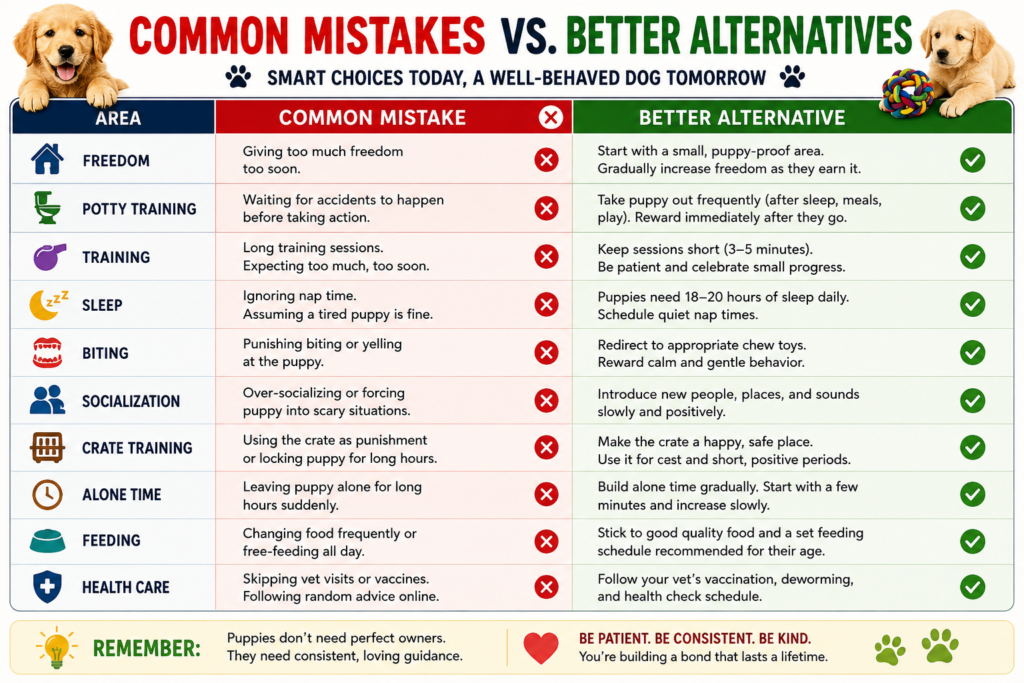
A Simple First-Month Comparison
| Area | Beginner Mistake | Better Approach |
|---|---|---|
| Potty training | Wait for accidents | Create frequent opportunities |
| Training | Long sessions | Short positive sessions |
| Sleep | Constant stimulation | Scheduled naps |
| Socialization | Meet everyone | Calm, controlled exposure |
| Freedom | Entire house | Gradual access |
| Biting | Punishment | Redirect to appropriate chewing |
| Crate | Forced confinement | Positive association |
| Alone time | Suddenly leave for hours | Build gradually |
| Exercise | Exhaust the puppy | Balance play and rest |
| Health | Guess vaccination needs | Follow veterinarian plan |
This table captures the central philosophy of the First 30 Days With a New Puppy:
Prevent problems before you need to correct them.
When Your Puppy Seems “Bad”
This deserves special attention.
A puppy isn’t necessarily being stubborn when they ignore you.
They may be:
- Tired
- Hungry
- Overstimulated
- Confused
- Distracted
- In need of the bathroom
- Teething
- Unfamiliar with the cue
- Asking for attention
- Experiencing discomfort
Before correcting behavior, ask:
“What need might be underneath this behavior?”
That question can completely change how you train your dog.
Red Flags: When to Contact a Veterinarian
Puppies can become ill quickly, and owners should not attempt to diagnose serious illness through internet articles.
Contact your veterinarian promptly if you notice concerning symptoms such as:
- Significant lethargy
- Repeated vomiting
- Persistent diarrhea
- Refusal to eat or drink
- Difficulty breathing
- Collapse
- Severe weakness
- Bloated abdomen
- Blood in vomit or stool
- Seizure
- Severe pain
- Sudden major behavioral changes
AKC notes that while puppies naturally sleep a lot, unusual lethargy or a puppy that seems markedly unwell warrants attention.
For emergencies, contact a veterinary hospital or emergency veterinary service rather than waiting for symptoms to resolve.
The Most Important Mindset for New Puppy Owners
The biggest lesson from the First 30 Days With a New Puppy isn’t actually about commands.
It’s about expectations.
Your puppy will have accidents.
They will probably bite something they shouldn’t.
They may cry.
They may wake you at night.
They may forget a behavior they appeared to understand yesterday.
They may have days when training seems to go backward.
That’s normal.
Puppy development isn’t a straight line.
One good day does not mean the puppy is fully trained.
One terrible day does not mean you’ve failed.
The goal is to create enough repetition that the desired behavior gradually becomes easier and more natural.
Your 30-Day Puppy Survival Checklist
Week 1
- Puppy-proof the home
- Establish a safe puppy area
- Schedule veterinary care
- Review vaccination records
- Establish feeding times
- Begin potty routine
- Introduce sleeping area
- Start name recognition
- Begin gentle handling
- Protect nap time
Week 2
- Continue potty training
- Introduce basic cues
- Start positive crate training
- Introduce safe new experiences
- Practice calm handling
- Begin short alone-time sessions
- Establish consistent bedtime
Week 3
- Gradually increase supervised freedom
- Continue socialization
- Practice recall games
- Reinforce appropriate chewing
- Continue handling exercises
- Review progress with your veterinarian if needed
Week 4
- Strengthen the daily routine
- Practice calm settling
- Increase training gradually
- Continue safe social experiences
- Review toilet-training progress
- Identify remaining problem areas
- Plan the next month’s training goals
What You Should NOT Expect After 30 Days
This is just as important as knowing what you should expect.
Don’t expect your puppy to:
- Never have an accident
- Never bite
- Sleep perfectly every night
- Come every single time
- Stay alone all day
- Ignore every distraction
- Understand every household rule
- Behave like an adult dog
The First 30 Days With a New Puppy are about building the foundation—not finishing the house.
Think of month one as installing the operating system.
The advanced features come later.
Final Thoughts: Make the First Month About Trust
The First 30 Days With a New Puppy can be messy, exhausting, hilarious, and surprisingly emotional.
You may clean the same floor several times in one day.
You may wonder why your puppy sleeps for an hour and then suddenly behaves like a tiny tornado.
You may lose a slipper.
You may lose sleep.
But you’ll also experience the first time your puppy responds to their name, chooses their toy instead of your shoe, settles beside you, sleeps peacefully in their bed, or looks at you for guidance in a completely new environment.
Those moments are the real progress.
Don’t try to create a perfect dog in 30 days.
Create a dog who trusts you.
Create predictable routines.
Reward the behavior you want.
Prevent situations your puppy isn’t ready to handle.
Give them enough sleep.
Socialize thoughtfully.
Follow veterinary guidance.
And remember that every small successful interaction is teaching your puppy what life with you will be like.
If you approach the First 30 Days With a New Puppy with patience rather than perfection, you won’t just survive the first month—you’ll build the foundation for a happier relationship for years to come.
Suggested Internal Content
CutePawWorld, this article can internally link to related articles such as:
- Potty Training a Puppy in 7 Days: Amazing Tips For Guaranteed Success
- Signs Your Puppy Is Mentally Bored (Not Physically Tired): 15 Hidden Warning Signs
- Why Is My Puppy Eating Mulch and Dirt? 9 Hidden Causes, Serious Risks & Proven Solutions (2026 Guide)
- 15 Powerful Signs Your Puppy Loves You (Don’t Ignore These Hidden Clues)
- 25 Cutest Dog Breeds That Stay Adorable Forever (Avoid These Common Mistakes Before Choosing One)
- 10 Best Slow Feeder Dog Bowls for Fast Eaters (2026): Stop Dangerous Gulping & Improve Digestion
Recommended External Links
- AAHA Canine Vaccination Guidelines — vaccination section mein
AAHA Canine Vaccination Guidelines - AVSAB Puppy Socialization Position Statement — socialization section mein
AVSAB Puppy Socialization Resources - RSPCA Puppy Toilet Training Guide — potty-training section mein
RSPCA Puppy Toilet Training Guide - AAHA Puppy Vaccination & Health Information — veterinary/health section mein
AAHA Pet Vaccination Guide
Frequently Asked Questions
First 30 Days With a New Puppy
How difficult are the First 30 Days With a New Puppy?
They can be demanding because puppies need frequent potty breaks, supervision, sleep, training, feeding, and socialization. The difficulty usually becomes more manageable once a predictable routine develops.
How long does potty training take?
There is no universal timeline. Age, previous experience, supervision, routine, health, and consistency all matter. Frequent opportunities and immediate rewards can help establish the desired habit.
Should I wake my puppy during the day?
Usually, puppies need substantial sleep, and uninterrupted rest is important. Rather than constantly stimulating a sleeping puppy, allow appropriate naps and provide a quiet resting area.
Can my puppy socialize before being fully vaccinated?
Ask your veterinarian about your puppy’s individual risk and safe options. AVSAB supports carefully managed early socialization rather than simply waiting until the entire vaccination series is complete.
Should I punish my puppy for biting?
Punishment is generally not the best teaching strategy. Redirect biting toward appropriate toys and reinforce calm, desirable behavior.
Should a puppy sleep in a crate?
A crate can be a useful safe resting and confinement area when introduced positively and used appropriately. It should not become a place of punishment.
Conclusion: Building a Happy Life Together
The First 30 Days With a New Pupp can feel challenging, exciting, messy, and incredibly rewarding all at the same time. Your puppy is not expected to understand everything immediately, and you don’t need to become a perfect pet parent overnight.
The real purpose of the First 30 Days With a New Pupp is to create a safe environment, establish predictable routines, and begin building trust through patience and positive experiences.
During the First 30 Days With a New Pupp, focus on the basics: consistent potty training, nutritious meals, plenty of sleep, gentle training, safe socialization, appropriate play, and regular veterinary care. These small daily habits can make a huge difference as your puppy grows.
Remember that the First 30 Days With a New Pupp are only the beginning. Some puppies learn quickly, while others need more repetition and patience. Accidents, chewing, barking, biting, and occasional setbacks are normal parts of puppy development.
The most important lesson from the First 30 Days With a New Puppy is to choose consistency over perfection. Reward the behavior you want, prevent situations your puppy isn’t ready for, and give them plenty of opportunities to succeed.
Finally, enjoy the First 30 Days With a New Pupp. Take photographs, celebrate the small victories, and appreciate those funny little moments that you’ll eventually miss. You’re not simply training a puppy—you’re building the foundation of a lifelong friendship.
Be patient. Be consistent. Be kind. And remember: today’s tiny puppy can become tomorrow’s confident, happy, and loving companion. 🐶❤️