


Introduction: Is Your Dog’s Food Causing the Problem?
Your dog finishes dinner, looks perfectly happy, and then a few hours later you hear the unmistakable sound of an unhappy stomach.
Gas.
Loose stool.
Gurgling.
Vomiting.
Or a dog suddenly refusing food.
If this sounds familiar, you’re probably searching for the Best Dog Food for Sensitive Stomach and wondering which products are genuinely worth trying.
The difficult part is that “sensitive stomach” isn’t a single veterinary diagnosis. Digestive symptoms can have many causes, including sudden diet changes, eating garbage or table scraps, parasites, food intolerance, infections, pancreatitis, inflammatory bowel disease, and other medical conditions.
That is why choosing food based only on a dramatic package claim such as “natural,” “premium,” or “limited ingredient” can be misleading.
The World Small Animal Veterinary Association (WSAVA) recommends looking beyond marketing language and paying attention to nutritional adequacy, manufacturer information, quality control, research, and whether the food is appropriate for the individual animal.
So, what actually makes a good Best Dog Food for Sensitive Stomach?
Usually, it is not about finding the food with the longest ingredient list or the most exotic protein. Instead, the goal is to find a nutritionally complete diet that your dog tolerates well and that matches the reason behind the digestive problem.
This guide compares several strong 2026 options and explains when each type makes sense, when it may not, and when a veterinarian should become part of the decision.
Important: This article is educational and does not replace veterinary diagnosis or individualized feeding advice. Dogs with persistent vomiting, diarrhea, blood in the stool, significant lethargy, abdominal pain, dehydration, weight loss, or loss of appetite should be evaluated by a veterinarian.
What Does “Sensitive Stomach” Actually Mean?
Before choosing the Best Dog Food for Sensitive Stomach, it helps to understand what owners usually mean by the phrase.
A dog with a food-sensitive digestive system may experience:
- Soft or inconsistent stools
- Excessive gas
- Occasional vomiting
- Loud intestinal noises
- Reduced appetite
- Difficulty adjusting to new foods
- Recurrent digestive upset after eating certain foods
But these signs don’t automatically mean your dog has a food allergy.
A true food allergy involves an immune response. A food intolerance can produce digestive symptoms without the same immune mechanism.
And sometimes the food isn’t the problem at all.
For example, a dog that steals greasy leftovers from the kitchen may develop diarrhea even though its regular food is perfectly suitable.
That distinction matters because the Best Dog Food for Sensitive Stomach for one dog could be completely inappropriate for another.
Our 2026 Shortlist
After comparing veterinary nutrition principles, manufacturer information, digestive-support features, and the different situations in which dogs may need dietary management, these are the categories and products worth discussing with your veterinarian.
| Food / Diet | Best For | Type | Key Strength |
|---|---|---|---|
| Hill’s Science Diet Sensitive Stomach & Skin | Healthy adult dogs with mild digestive sensitivity | Over-the-counter | Highly digestible + prebiotic fiber |
| Purina Pro Plan Sensitive Skin & Stomach | Dogs needing an everyday sensitive-stomach formula | Over-the-counter | Salmon-first formula + prebiotic fiber |
| Hill’s Prescription Diet i/d | Dogs with digestive upset requiring therapeutic nutrition | Veterinary diet | Highly digestible + digestive-support technology |
| Royal Canin Gastrointestinal Low Fat | Dogs needing fat restriction | Veterinary diet | Low-fat digestive support |
| Purina Pro Plan Veterinary Diets EN Gastroenteric | Dogs needing veterinary GI nutritional management | Veterinary diet | Highly digestible GI-focused formulation |
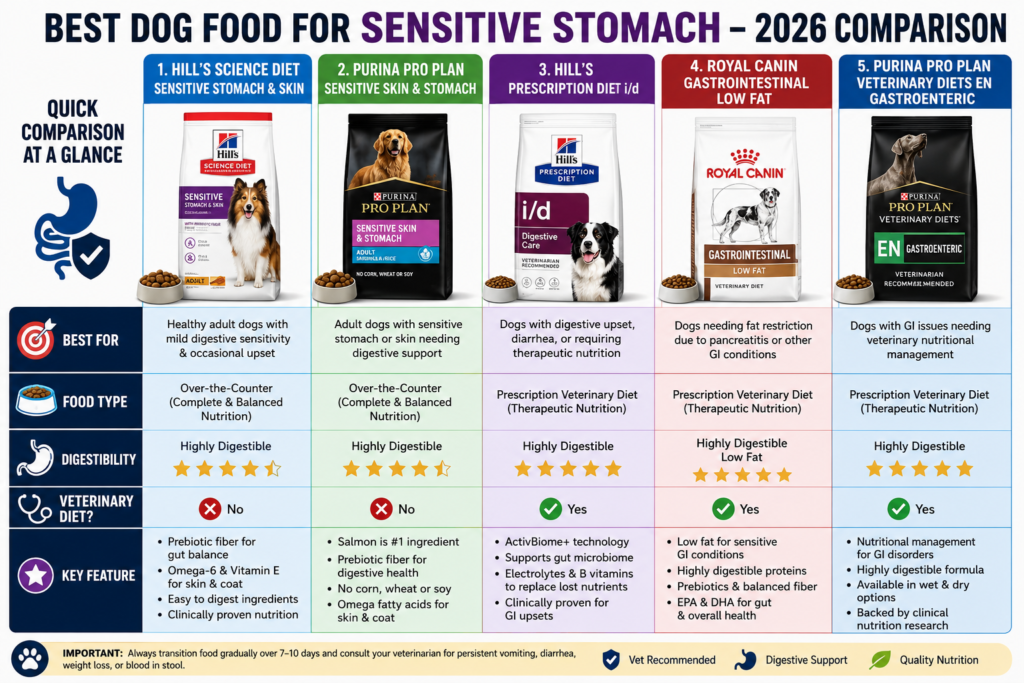
The key takeaway is simple: the Best Dog Food for Sensitive Stomach depends on why your dog is sensitive.
1. Hill’s Science Diet Sensitive Stomach & Skin
For a generally healthy adult dog that experiences occasional digestive sensitivity, Hill’s Science Diet Adult Sensitive Stomach & Skin is one of the more straightforward options to consider.
The manufacturer describes the formula as highly digestible and designed to support digestive and skin health. It also contains prebiotic fiber. Hill’s states that its adult formula is substantiated through AAFCO feeding tests for maintenance of adult dogs.
Why it stands out
The interesting thing about this formula isn’t simply the word “sensitive” printed on the package.
The more meaningful features are:
- Highly digestible formulation
- Prebiotic fiber
- Complete and balanced adult nutrition
- Omega-3 and omega-6 fatty acids
- Multiple protein/flavor options
- A formulation specifically marketed toward digestive and skin support
Hill’s currently offers variants including salmon and brown rice as well as chicken and barley.
Who should consider it?
This may be a practical starting point for an otherwise healthy adult dog whose digestive system doesn’t seem to appreciate frequent food changes or richer diets.
It is not automatically the right answer for puppies, pregnant dogs, nursing dogs, or dogs with diagnosed gastrointestinal disease. Hill’s specifically lists its adult Sensitive Stomach & Skin formula as not recommended for puppies and pregnant or nursing dogs.
Our take: Strong everyday candidate, but not a substitute for a therapeutic veterinary diet when a medical condition is suspected.
2. Purina Pro Plan Sensitive Skin & Stomach
Another popular option in the everyday Best Dog Food for Sensitive Stomach category is Purina Pro Plan Sensitive Skin & Stomach.
The current salmon-and-rice dry formula lists salmon as its first ingredient and includes prebiotic fiber. Purina describes it as highly digestible and designed to support digestive health.
What makes it interesting?
The formula combines:
- Salmon as the first ingredient
- Rice and oatmeal
- Prebiotic fiber
- Fish oil
- Omega fatty acids
- No artificial colors or flavors
- No corn, wheat, or soy in the listed formula
That makes it an interesting option for owners who want an everyday sensitive-stomach formula without immediately moving to a prescription diet.
However, there is an important point many owners miss.
Grain-free does not automatically mean better for digestion.
Likewise, the presence of grains doesn’t automatically make a food unsuitable.
WSAVA specifically cautions owners against relying too heavily on ingredient lists as a measure of food quality because ingredient lists alone don’t tell you the full nutritional or manufacturing story.
Who is it best for?
A healthy adult dog with relatively mild digestive sensitivity may be a reasonable candidate.
But if your dog has chronic diarrhea, recurrent vomiting, suspected food allergy, pancreatitis, or unexplained weight loss, don’t keep changing ordinary foods indefinitely.
That is when veterinary evaluation becomes much more important.
The Biggest Mistake Owners Make When Choosing Food
One of the most useful lessons from veterinary nutrition guidance is that the ingredient list should not be your only decision-making tool.
Imagine two dog foods.
Food A has an impressive-looking ingredient list filled with blueberries, exotic meat, herbs, vegetables, and other ingredients.
Food B has a simpler ingredient list but comes from a manufacturer that can provide detailed nutritional information, quality-control information, feeding guidance, and evidence supporting the formulation.
Which is better?
You can’t reliably answer that question just by reading the front of the bag.
WSAVA’s nutrition guidance specifically recommends looking at factors beyond marketing terminology and the ingredient list when evaluating pet food.
This is one reason our definition of Best Dog Food for Sensitive Stomach focuses on formulation, digestibility, nutritional adequacy, the dog’s individual needs, and veterinary assessment rather than marketing claims.
How to Read a Dog Food Label Like a Pro
When you’re comparing the Best Dog Food for Sensitive Stomach, don’t stop at the words “sensitive,” “natural,” or “premium.”
Look for:
1. Nutritional adequacy
The food should be appropriate for your dog’s life stage and intended use.
2. Manufacturer transparency
A reputable manufacturer should be able to provide meaningful information about the food.
3. Digestibility
Highly digestible formulas can be particularly useful when a dog has gastrointestinal problems because the goal is to make nutrient absorption easier.
4. Calorie density
A food that looks healthy can still cause problems if you’re accidentally overfeeding it.
5. Appropriate fat level
Some dogs with specific gastrointestinal conditions may require dietary fat restriction.
6. Fiber profile
Fiber isn’t simply “good” or “bad.” Different types and amounts can have different effects on stool quality and intestinal function.
7. Your dog’s age and health
A diet designed for adult maintenance isn’t automatically suitable for a puppy or a dog with kidney, liver, pancreatic, or other medical conditions.
3. Hill’s Prescription Diet i/d
This is where the discussion moves from everyday sensitive-stomach food into therapeutic veterinary nutrition.
Hill’s Prescription Diet i/d is specifically formulated to help manage digestive upsets. The current product information describes it as highly digestible and includes ActivBiome+ technology, a proprietary prebiotic blend intended to support the gut microbiome. It also includes electrolytes and B vitamins to help replace nutrients lost during digestive problems.
This is fundamentally different from simply buying an over-the-counter food labeled “sensitive.”
Why might a veterinarian recommend it?
When a dog is actually experiencing gastrointestinal disease or significant digestive upset, the nutritional goals can become more specific.
A therapeutic diet may be selected because of:
- Digestibility
- Fat content
- Fiber characteristics
- Protein selection
- Electrolyte considerations
- Calorie density
- Clinical evidence and formulation expertise
That is why a prescription gastrointestinal diet can make more sense than endlessly switching supermarket foods.
Who is it for?
Dogs with digestive problems that require veterinary nutritional management.
It’s not something I would recommend choosing blindly simply because your dog occasionally has soft stool.
Our take: One of the stronger options when a veterinarian believes therapeutic gastrointestinal nutrition is appropriate.
Why “Low Fat” Can Matter
If you’re researching the Best Dog Food for Sensitive Stomach, you will eventually encounter low-fat veterinary diets.
This is important because not every digestive problem is simply about “sensitive digestion.”
Some dogs need nutritional management that specifically limits dietary fat.
Royal Canin Gastrointestinal Low Fat, for example, is a veterinary formula designed for dogs needing a fat-restricted diet. The current formula uses highly digestible proteins, balanced fiber, prebiotics, and EPA/DHA to support digestive health.
That doesn’t mean every dog with diarrhea needs low-fat food.
It means dietary fat level should sometimes be selected for a medical reason rather than a generic idea that “low fat is healthier.”
4. Royal Canin Gastrointestinal Low Fat
Royal Canin Gastrointestinal Low Fat deserves consideration when the dog’s problem specifically involves the need for dietary fat restriction.
The manufacturer identifies it as a veterinary-exclusive formula and recommends consulting a veterinarian to determine whether it is appropriate for an individual dog.
Key features
- Fat-restricted formulation
- Highly digestible proteins
- Balanced fiber
- Prebiotics
- EPA and DHA
- Complete and balanced adult nutrition
Royal Canin’s current U.S. formulation is listed as meeting AAFCO Dog Food Nutrient Profiles for adult maintenance.
Who should consider it?
Not the average healthy dog.
This is a much more targeted option for dogs whose veterinary assessment indicates a low-fat diet may be beneficial.
That distinction is important when creating a genuinely responsible Best Dog Food for Sensitive Stomach guide.
Quick Decision Guide
If you’re still confused, use this simple framework:
Mild sensitivity, otherwise healthy adult dog
Consider an everyday sensitive-stomach formula such as Hill’s Science Diet Sensitive Stomach & Skin or Purina Pro Plan Sensitive Skin & Stomach.
Repeated digestive problems
Stop guessing and speak with your veterinarian.
Suspected food allergy or dietary sensitivity
Your veterinarian may recommend a controlled elimination trial using a novel-protein or hydrolyzed diet.
Fat-sensitive gastrointestinal disease
A veterinary low-fat diet may be appropriate.
Severe or persistent symptoms
Don’t experiment with multiple foods at home. Get veterinary evaluation.
5. Purina Pro Plan Veterinary Diets EN Gastroenteric
Purina Pro Plan Veterinary Diets EN Gastroenteric is another important option when the dog needs veterinary gastrointestinal nutritional management.
Purina’s current veterinary range includes EN Gastroenteric formulas, EN Gastroenteric Low Fat, Fiber Balance, and hydrolyzed-protein diets.
The standard EN Gastroenteric formula is designed around gastrointestinal support and is highly digestible. Purina’s product documentation states that it is formulated to meet AAFCO nutritional profiles for growth and adult maintenance, including large-size puppies.
Why it makes our shortlist
The value here is not that one brand magically fixes every stomach.
It’s that veterinary gastrointestinal diets allow nutritional management to become more specific.
For example, Purina’s EN range includes:
- Standard gastrointestinal formulas
- Low-fat gastrointestinal formulas
- Fiber-balance formulas
- Wet formulas
- Hydrolyzed-protein formulas
That range gives veterinarians more tools when the underlying problem differs from dog to dog.
6. Hydrolyzed Protein Diets: When “Sensitive Stomach” Is Actually Food Sensitivity
Here’s one of the most important insights in this entire guide.
Sometimes the problem isn’t that your dog has a “weak stomach.”
The problem may be a dietary reaction.
When food sensitivity is suspected, veterinarians may use a novel-protein or hydrolyzed-protein elimination diet.
Merck Veterinary Manual explains that novel-antigen diets and hydrolyzed diets can be effective in dogs with chronic enteropathy. It also notes that an elimination trial must be truly exclusive to be useful; treats and other foods can undermine the trial.
Purina’s current veterinary range includes several HA Hydrolyzed Protein formulas, including chicken, salmon, and vegetarian options.
Royal Canin also offers a Gastrointestinal Low Fat + Hydrolyzed Protein formula designed around low fat and hydrolyzed protein.
The hidden problem with DIY food trials
An owner may think:
“I’ll give my dog chicken and rice for two weeks.”
But if the dog also receives chicken-flavored treats, chew sticks, table scraps, flavored medication, or another pet’s food, the trial may not tell you what you think it tells you.
A veterinary elimination diet has to be controlled.
This is one area where professional guidance can save weeks or months of trial and error.
What About Chicken and Rice?
Chicken and rice has become almost synonymous with an upset dog stomach.
There is a reason people use it: bland, easily digested foods can sometimes be useful in specific short-term situations.
But it shouldn’t automatically become a permanent diet.
A homemade chicken-and-rice mixture can also be nutritionally incomplete if used long-term.
The Best Dog Food for Sensitive Stomach for long-term feeding should generally be a complete and balanced diet appropriate for the dog’s life stage and medical needs.
If your dog repeatedly needs a bland diet just to keep stools normal, that is a reason to investigate the underlying issue rather than endlessly repeating the same home recipe.
How to Switch Foods Without Creating Another Stomach Problem
You found the Best Dog Food for Sensitive Stomach.
Great.
Now don’t ruin the transition by changing everything overnight.
A sudden diet change can itself trigger digestive upset.
Hill’s currently recommends transitioning its sensitive-stomach foods over approximately seven days, gradually increasing the new food while decreasing the old food.
A practical transition can look like this:
| Day | Old Food | New Food |
|---|---|---|
| 1–2 | 75% | 25% |
| 3–4 | 50% | 50% |
| 5–6 | 25% | 75% |
| 7 | 0% | 100% |
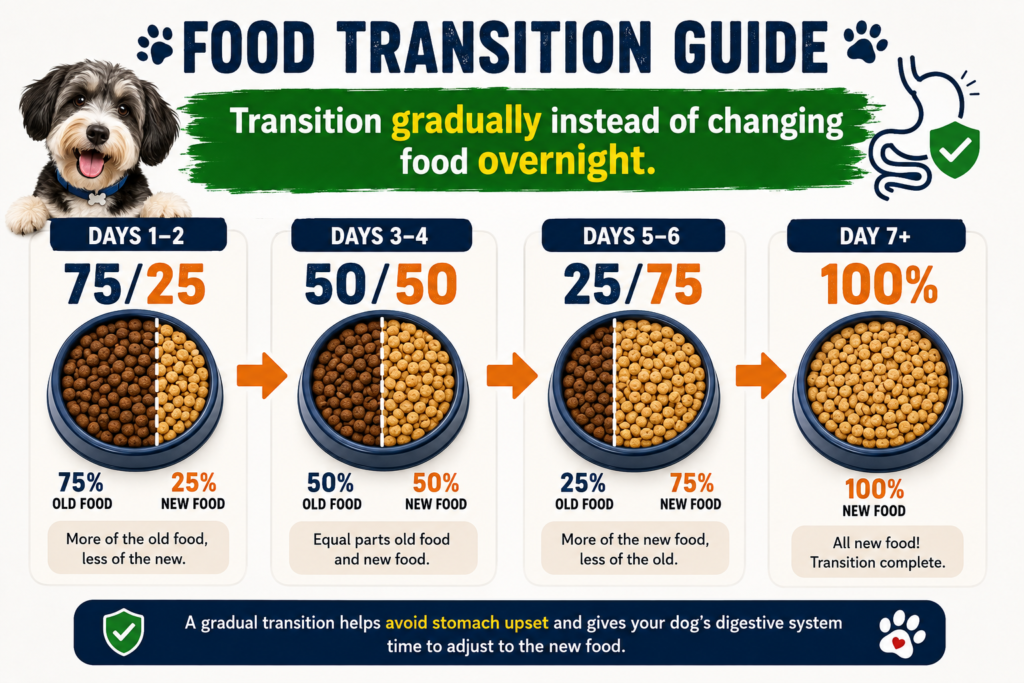
Some dogs need a slower transition.
If stool quality deteriorates substantially during the switch, stop treating the calendar as more important than the dog. Contact your veterinarian if symptoms are significant or persistent.
Don’t Forget the Treats
Here’s a surprisingly common reason a “sensitive stomach diet” appears not to work.
The main food is carefully selected.
Then the dog receives:
- Biscuits
- Cheese
- Table scraps
- Dental chews
- Training treats
- Leftover meat
- Flavored supplements
- Food from another family member
Suddenly, the dog isn’t actually eating the controlled diet.
This matters especially during an elimination trial.
Merck Veterinary Manual specifically notes that dogs undergoing a dietary trial for suspected chronic enteropathy should receive the trial diet exclusively, without treats.
How Long Should You Test a New Food?
There isn’t one universal number for every situation.
A dog with a simple food-transition problem may respond relatively quickly.
A dog undergoing a controlled elimination trial for suspected dietary sensitivity may require a much more structured period under veterinary supervision.
Merck notes that a hypoallergenic novel-protein or hydrolyzed diet should be fed exclusively for at least two weeks to judge efficacy in dogs with chronic enteropathy, with no treats during the trial.
That doesn’t mean every dog should independently perform a two-week experiment.
The correct duration and diet depend on the suspected disease and clinical circumstances.
Dry Food vs Wet Food: Which Is Better?
When choosing the Best Dog Food for Sensitive Stomach, owners often ask whether dry food or wet food is superior.
There isn’t a universal winner.
Dry food
Advantages can include:
- Convenient storage
- Easy portion measurement
- Usually more calorie-dense
- Easy for many owners to use consistently
Wet food
Potential advantages include:
- High moisture content
- Different texture and palatability
- Useful for dogs that prefer softer food
- Can be combined with some therapeutic feeding plans
For example, Hill’s offers sensitive-stomach wet formulas, while Royal Canin and Purina offer wet gastrointestinal veterinary diets.
The better choice is usually the one that fits the dog’s nutritional needs, medical condition, preferences, and the veterinarian’s plan.
What Ingredients Should You Look For?
There is no magical ingredient that automatically creates the Best Dog Food for Sensitive Stomach.
Instead, think in terms of formulation.
Highly digestible proteins
Digestibility can matter when the gastrointestinal tract is struggling.
Appropriate carbohydrates
Rice, oats, barley, potatoes, and other carbohydrate sources can all appear in legitimate dog foods. Their presence doesn’t automatically make a food good or bad.
Functional fiber
Certain fiber types can support stool quality and intestinal function.
Prebiotics
Some formulas include prebiotic fibers intended to support beneficial intestinal microorganisms.
Appropriate fat level
This becomes particularly important for dogs that require fat restriction.
Complete nutrition
A food should provide the nutrients required for the intended life stage and feeding purpose.
The most important lesson is that the entire formulation matters more than one fashionable ingredient.
Ingredients You Don’t Automatically Need to Fear
The internet has created plenty of ingredient villains.
Corn.
Wheat.
By-products.
Animal fat.
Grains.
None of these words, by themselves, tell you whether a food is nutritionally appropriate for your dog.
Likewise, “grain-free” isn’t synonymous with “better.”
WSAVA’s nutrition resources emphasize that ingredient lists can be misleading when used as the primary method of evaluating pet-food quality.
Instead of asking:
“Does this food contain ingredient X?”
Ask:
“Is this complete, balanced, appropriate for my dog’s life stage, made by a transparent manufacturer, and suitable for my dog’s individual medical needs?”
That’s a much better question.
Signs That Your Dog Needs a Veterinarian Instead of a New Food
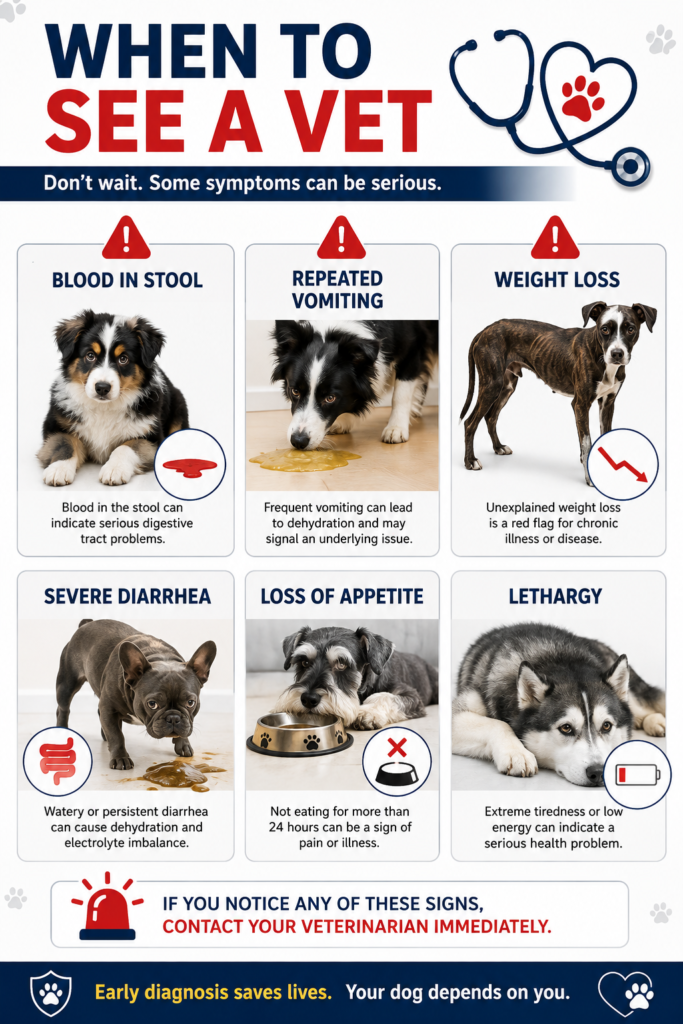
Searching for the Best Dog Food for Sensitive Stomach is reasonable when the problem is mild and occasional.
But food should not become a substitute for diagnosis.
Contact a veterinarian promptly if your dog has:
- Repeated vomiting
- Blood in stool
- Black/tarry stool
- Severe or persistent diarrhea
- Significant abdominal pain
- Marked weakness or lethargy
- Dehydration
- Refusal to eat
- Unexplained weight loss
- Recurrent digestive episodes
- A swollen or painful abdomen
- Symptoms after ingesting a potentially toxic substance
Puppies, elderly dogs, and dogs with existing medical conditions deserve particular caution.
Our Final 2026 Ranking
Here is how we would organize the Best Dog Food for Sensitive Stomach options by situation rather than simply declaring one universal winner.
| Rank | Product | Best Use | Our View |
|---|---|---|---|
| 1 | Hill’s Science Diet Sensitive Stomach & Skin | Mild everyday sensitivity | Excellent starting point for appropriate adult dogs |
| 2 | Purina Pro Plan Sensitive Skin & Stomach | Everyday digestive sensitivity | Strong alternative with digestive-support features |
| 3 | Hill’s Prescription Diet i/d | Veterinary GI management | Excellent when therapeutic nutrition is indicated |
| 4 | Royal Canin Gastrointestinal Low Fat | Fat-restricted GI management | Highly targeted veterinary option |
| 5 | Purina Pro Plan Veterinary Diets EN Gastroenteric | Veterinary GI management | Versatile therapeutic range |
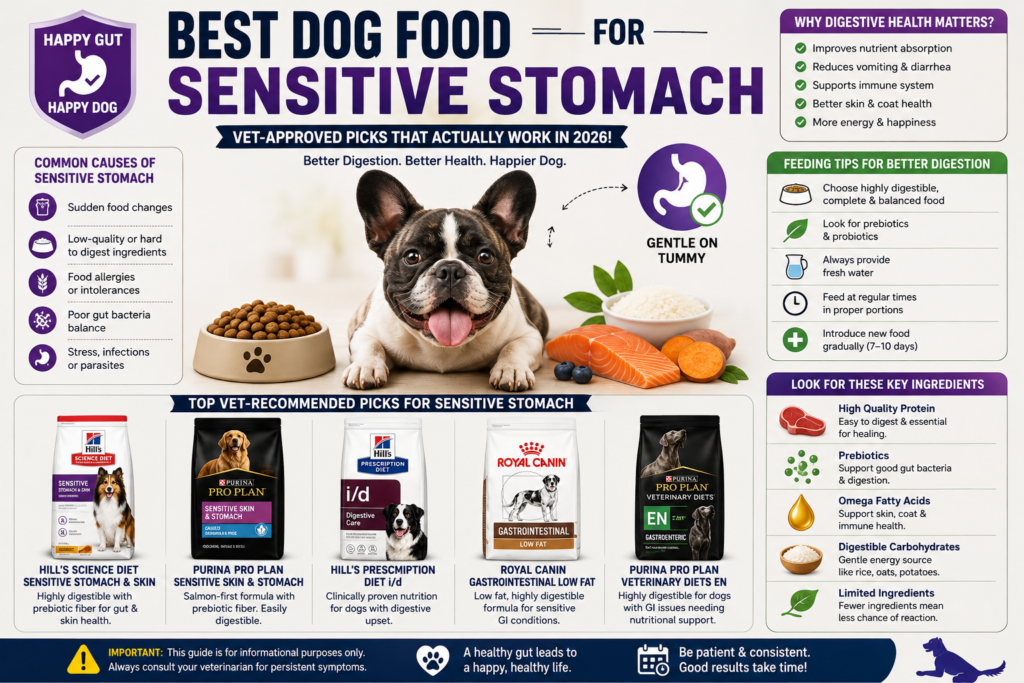
These rankings are not a substitute for a veterinarian’s recommendation. They are a practical way to understand which type of diet fits which situation.
The Best Food Isn’t Always the Most Expensive Food
One of the biggest misconceptions in pet nutrition is that higher price automatically means better health.
It doesn’t.
The best food is the one that:
- Meets your dog’s nutritional requirements.
- Is appropriate for its life stage.
- Is tolerated well.
- Fits its medical needs.
- Can be fed consistently.
- Comes from a manufacturer with appropriate quality and nutritional information.
WSAVA’s guidelines are particularly useful here because they encourage owners to look beyond marketing claims and evaluate the manufacturer’s expertise, nutritional information, research, and quality-control practices.
A Simple 7-Step Sensitive-Stomach Plan
If your dog has mild recurring digestive sensitivity, here’s a practical framework to discuss with your veterinarian:
Step 1: Record the symptoms
Write down what your dog eats and when symptoms occur.
Step 2: Stop random food switching
Changing foods every few days makes it difficult to identify patterns.
Step 3: Choose an appropriate complete diet
Use your dog’s age, size, health status, and symptoms to guide the choice.
Step 4: Transition gradually
Give the digestive system time to adapt.
Step 5: Control treats
Especially important if a dietary trial is being performed.
Step 6: Monitor stool and appetite
Look for consistent improvement rather than a single good bowel movement.
Step 7: Escalate to veterinary care when needed
Persistent symptoms deserve investigation.
Frequently Asked Questions
What is the Best Dog Food for Sensitive Stomach?
There isn’t one universal winner. For otherwise healthy adult dogs with mild sensitivity, Hill’s Science Diet Sensitive Stomach & Skin and Purina Pro Plan Sensitive Skin & Stomach are reasonable everyday options to discuss with your veterinarian. Dogs with diagnosed gastrointestinal disease may need a therapeutic diet instead.
Is expensive dog food better for sensitive stomachs?
Not necessarily. Formulation, digestibility, nutritional adequacy, manufacturing quality, and individual tolerance are more useful criteria than price alone.
Is grain-free food better for sensitive stomachs?
Not automatically. Grain-free does not equal more digestible or healthier. The complete formulation matters more than whether grains are present.
Can I give chicken and rice every day?
Chicken and rice may be used in certain short-term situations, but a homemade chicken-and-rice diet is not automatically nutritionally complete for long-term feeding.
Should I change food if my dog has diarrhea?
That depends on the severity and cause. Mild isolated digestive upset may have a simple explanation, but repeated or severe diarrhea warrants veterinary assessment rather than endless food changes.
What is the best food for suspected food allergy?
A veterinarian may recommend a controlled elimination trial using a novel-protein or hydrolyzed-protein diet. The diet must generally be fed exclusively during the trial for the results to be meaningful.
How quickly should a new food work?
It varies. Simple digestive intolerance may improve relatively quickly, while therapeutic dietary trials require a more structured approach. Don’t judge a diet solely on one meal or one bowel movement.
Can treats cause digestive problems?
Absolutely. Treats and table scraps can contribute to digestive upset and can completely undermine a controlled elimination diet.
Internal Links
CutePawWorld helps dog parents find the Best Dog Food for Sensitive Stomach, along with practical tips on dog nutrition, feeding, health, grooming, and everyday care. Explore our guides to keep your furry friend happy, healthy, and active.
- Potty Training a Puppy in 7 Days: Amazing Tips For Guaranteed Success
- Signs Your Puppy Is Mentally Bored (Not Physically Tired): 15 Hidden Warning Signs
- Why Is My Puppy Eating Mulch and Dirt? 9 Hidden Causes, Serious Risks & Proven Solutions (2026 Guide)
- 15 Powerful Signs Your Puppy Loves You (Don’t Ignore These Hidden Clues)
- 25 Cutest Dog Breeds That Stay Adorable Forever (Avoid These Common Mistakes Before Choosing One)
- 10 Best Slow Feeder Dog Bowls for Fast Eaters (2026): Stop Dangerous Gulping & Improve Digestion
- First 30 Days With a New Puppy: The Ultimate Survival Guide to Avoid Common Mistakes & Raise a Happy Dog
Final Verdict
So, after looking beyond marketing claims, what is the Best Dog Food for Sensitive Stomach in 2026?
The honest answer is: it depends on the dog.
For an otherwise healthy adult dog with mild digestive sensitivity, Hill’s Science Diet Sensitive Stomach & Skin and Purina Pro Plan Sensitive Skin & Stomach are two practical everyday options.
For a dog with significant or recurring gastrointestinal problems, veterinary therapeutic diets such as Hill’s Prescription Diet i/d, Royal Canin Gastrointestinal Low Fat, or Purina Pro Plan Veterinary Diets EN Gastroenteric may be more appropriate—but these should be selected with veterinary guidance.
And if your dog repeatedly vomits, has chronic diarrhea, loses weight, stops eating, or develops other concerning symptoms, don’t keep searching for a better bag of food.
Find out why the stomach is unhappy first.
The right diet can be incredibly helpful, but the smartest nutrition decision isn’t simply finding the food with the best marketing.
It’s finding the food that matches your dog’s biology, medical needs, lifestyle, and tolerance.
External links
- WSAVA Nutrition Guidelines → WSAVA Nutrition Guidelines
- Merck Veterinary Manual → Merck Veterinary Manual
- Hill’s Sensitive Stomach & Skin → Hill’s Official Product Page
- Purina Pro Plan Sensitive Skin & Stomach → Purina Official Product Page
- Royal Canin Gastrointestinal Low Fat → Royal Canin Official Product Page
🐾 Ready to Find the Right Food for Your Dog?
Before buying another bag, ask yourself:
Is this food appropriate for my dog’s age?
Is it nutritionally complete?
Does my dog actually tolerate it?
Am I controlling treats and table scraps?
Could there be an underlying medical problem?
If you can answer those questions, you’re already much closer to finding the Best Dog Food for Sensitive Stomach for your individual dog.
Share this guide with another dog parent who is dealing with digestive problems—and tell us which food your dog tolerates best.
Bilkul bhai. Conclusion mein exact keyword 10 baar naturally use kar raha hoon:
Conclusion: Choosing the Right Food for Your Dog
Finding the Best Dog Food for Sensitive Stomach isn’t about choosing the most expensive bag or following the latest pet-food trend. The Best Dog Food for Sensitive Stomach is the one that matches your dog’s age, health condition, nutritional requirements, and individual digestive tolerance.
For many otherwise healthy adult dogs, formulas such as Hill’s Science Diet Sensitive Stomach & Skin and Purina Pro Plan Sensitive Skin & Stomach are commonly recommended options. (Healthline)
However, the Best Dog Food for Sensitive Stomach can be very different for a dog with chronic diarrhea, vomiting, pancreatitis, food intolerance, or another diagnosed gastrointestinal condition. In those situations, your veterinarian may recommend a therapeutic diet rather than a standard sensitive-stomach formula.
When choosing the Best Dog Food for Sensitive Stomach, focus on complete and balanced nutrition, appropriate digestibility, consistent feeding, and your dog’s response to the diet. Remember that the Best Dog Food for Sensitive Stomach isn’t necessarily grain-free, expensive, or made with exotic ingredients.
A gradual transition is also important because suddenly changing diets can itself cause digestive upset. And if you’re trying to identify a food sensitivity, treats and table scraps can make the process much harder.
Ultimately, the Best Dog Food for Sensitive Stomach should help your dog maintain healthy stools, appetite, energy, and overall wellbeing. If symptoms continue despite dietary changes, don’t keep switching foods endlessly—the Best Dog Food for Sensitive Stomach cannot replace a proper veterinary examination.
Your veterinarian can help determine whether your dog simply needs a more digestible everyday diet or whether a veterinary therapeutic formula is appropriate. With the right diagnosis, feeding strategy, and Best Dog Food for Sensitive Stomach, many dogs can enjoy calmer digestion and happier mealtimes.
The goal isn’t simply to find the Best Dog Food for Sensitive Stomach. It’s to find the right nutrition for your individual dog and keep them feeling their best.