
Introduction –
You leave your puppy alone for five minutes.
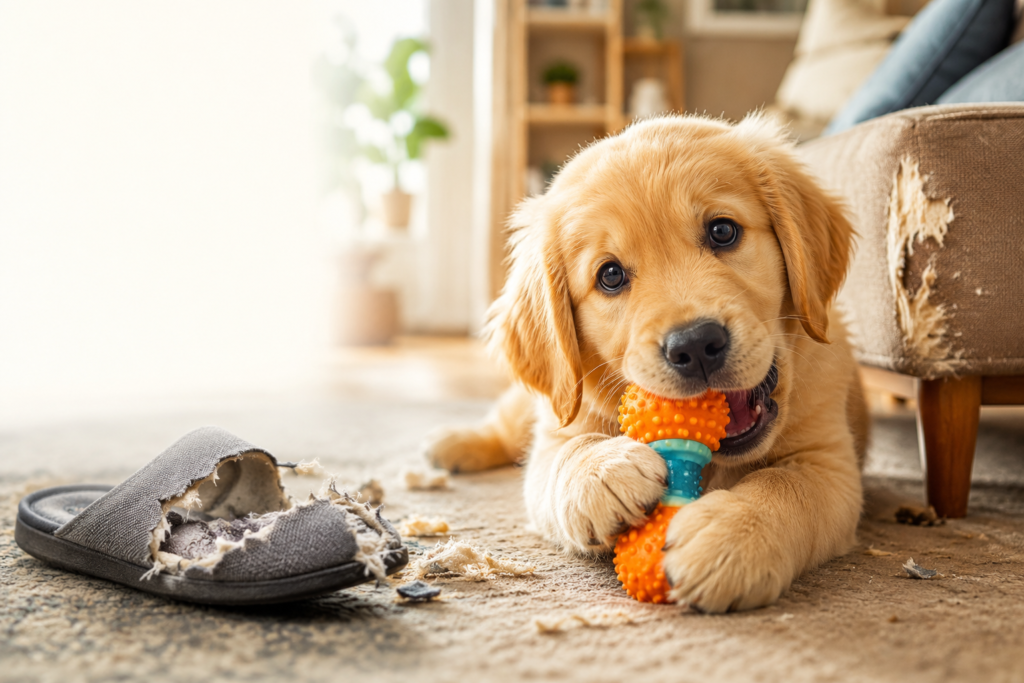
When you return, your slipper is missing, the corner of the table has fresh tooth marks, and somehow your puppy is sitting there looking completely innocent.
If you’re wondering, Puppy Biting Everything, you’re definitely not alone.
Puppies explore their environment with their mouths. Chewing can help them investigate objects, relieve teething discomfort, entertain themselves, and release frustration or boredom. In other words, your puppy usually isn’t trying to “destroy” your home on purpose.
The real goal isn’t to stop chewing altogether.
It’s to teach your puppy what is appropriate to chew, what isn’t, and what to do instead.
That’s an important distinction because chewing is a normal canine behavior. Trying to eliminate it completely can leave a puppy with no appropriate outlet for a very natural need.
The good news? With the right combination of management and training, Puppy Biting Everything can become a much more manageable problem.
Why Is My Puppy Biting Everything?
Before trying to fix the behavior, you need to understand what is driving it.
When Puppy Biting Everything happens, there are usually several possible reasons.
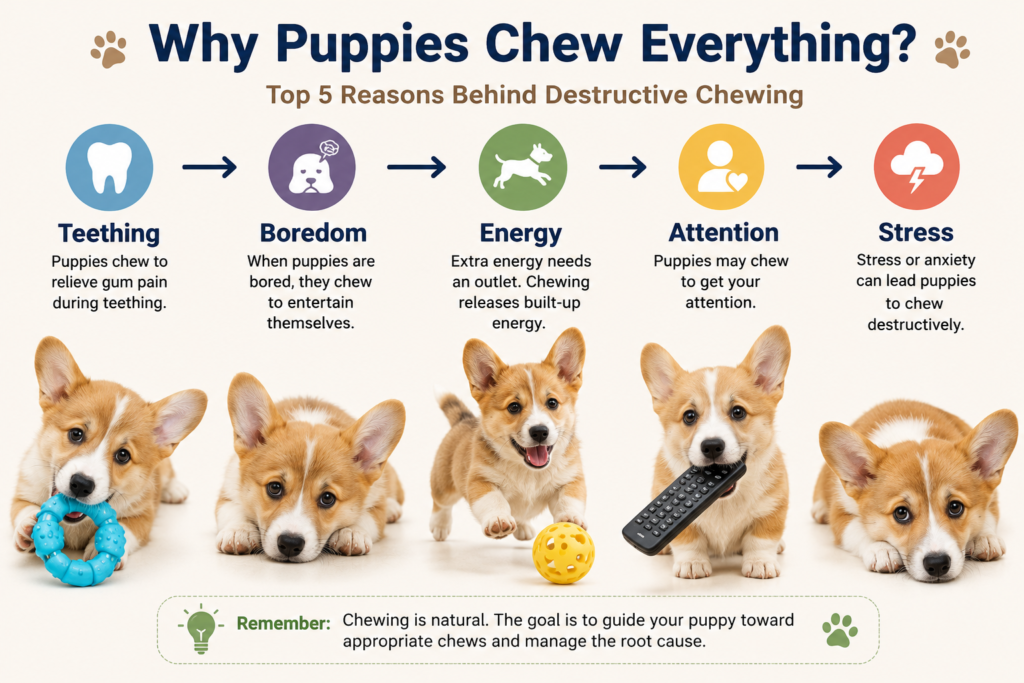
1. Teething
Teething is one of the biggest reasons young puppies suddenly seem obsessed with chewing.
Puppies have 28 baby teeth, and as their adult teeth develop, their gums can become uncomfortable. Chewing provides stimulation and may help relieve some of that discomfort.
This is why you may notice your puppy chewing: Puppy Biting Everything
- Furniture
- Shoes
- Clothing
- Toys
- Carpet
- Wooden objects
- Your hands and feet
The behavior isn’t necessarily a sign that your puppy is badly behaved.
It may simply mean their mouth needs something appropriate to do.
2. Boredom
A puppy with nothing interesting to do will often create entertainment.
And unfortunately, your expensive furniture can become the entertainment.
The ASPCA notes that chewing can help dogs deal with boredom, mild anxiety and frustration.
So if Puppy Biting Everything happens mostly when your puppy has been inactive for a while, boredom may be part of the problem.
3. Too Much Energy
Sometimes the issue isn’t lack of activity but lack of appropriate outlets.
A puppy may suddenly grab your socks, attack a cushion, or chase your feet because they are overstimulated and don’t know how to settle.
Physical activity, short training sessions, play and mental enrichment can all help provide better outlets.
4. Attention
Here’s something many owners accidentally teach.
Puppy grabs a shoe.
Owner immediately chases puppy.
Puppy runs away.
Suddenly, chewing the shoe has created the most exciting game of the day.
If Puppy Biting Everything results in chasing, shouting or dramatic attention, the puppy may learn that stealing objects is rewarding.
That’s why calm redirection is usually more useful than turning the incident into a wrestling match.
5. Separation-Related Stress
Pay attention to when the chewing occurs.
If your puppy mainly destroys doors, furniture or household objects when left alone, there could be a separation-related issue involved.
The ASPCA notes that destructive chewing associated with separation anxiety often occurs specifically during periods of isolation and may occur alongside behaviors such as whining, barking, pacing or house-soiling.
That situation needs a different strategy from ordinary puppy chewing.
Normal Puppy Chewing vs. Problem Chewing
Not every chewing behavior needs the same response.
| Behavior | Possible Reason | Best Response |
|---|---|---|
| Chewing a puppy toy | Normal exploration | Praise and allow |
| Chewing during teething | Gum discomfort | Offer suitable chew |
| Chewing furniture | Poor management or boredom | Interrupt and redirect |
| Chewing shoes | Interesting smell/texture | Remove access + offer toy |
| Biting hands during play | Excitement/play | Redirect and pause play |
| Destroying things when alone | Possible separation stress | Seek professional guidance |
| Swallowing objects | Safety concern | Contact a veterinarian |
This distinction matters because Puppy Biting Everything doesn’t automatically mean you have a “bad dog.”
It means you need to identify the reason behind the behavior.
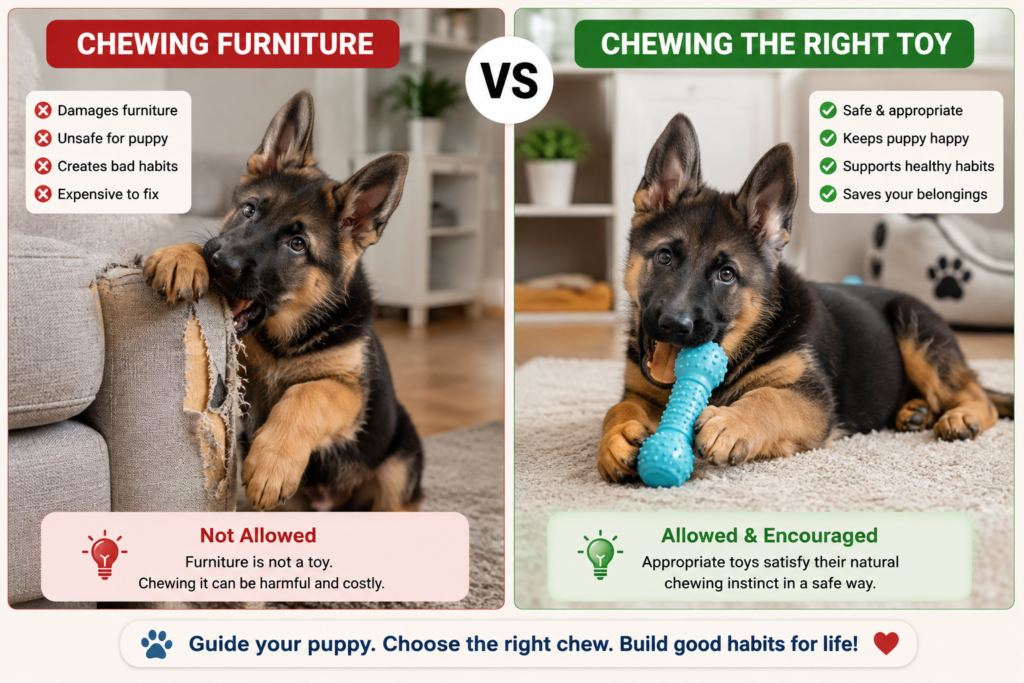
10 Proven Ways to Stop Destructive Chewing
1. Puppy-Proof Your Home
The first rule is simple:
Don’t make your puppy practice the behavior you are trying to stop.
If shoes are lying on the floor, electrical cables are exposed, laundry is accessible and books are within reach, you’re asking a curious puppy to make perfect decisions.
That’s unrealistic.
When Puppy Biting Everything becomes a daily problem, start by changing the environment.
Put away:
- Shoes
- Socks
- Children’s toys
- Remote controls
- Chargers
- Electrical cables
- Important documents
- Small objects
- Dirty laundry
- Easily damaged furniture items
Use baby gates, puppy pens or a safe puppy area when you cannot supervise.
The ASPCA specifically recommends dog-proofing the home and limiting access to tempting objects while the behavior is being trained.
The 10-second test
Walk through your home from your puppy’s perspective.
Ask:
“If I were a curious puppy, what could I reach right now?”
Anything dangerous or valuable should be moved.
Management isn’t cheating.
It’s training support.
2. Give Your Puppy Better Things to Chew
One of the biggest mistakes owners make is saying:
“Don’t chew that!”
…but never clearly showing the puppy what to chew.
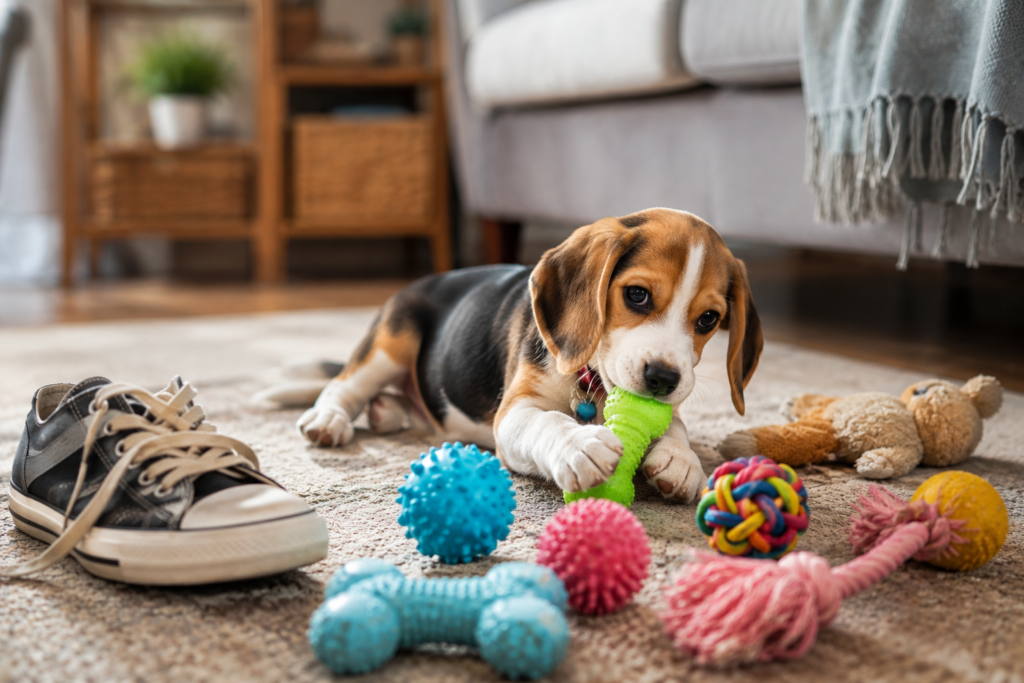
If Puppy Biting Everything is happening, your puppy needs attractive alternatives.
Keep several appropriate puppy chew toys available rather than relying on a single toy.
Different puppies prefer different textures.
Some enjoy soft rubber.
Others prefer textured toys.
Some like food-stuffed enrichment toys.
Others become interested in toys that can be chilled during teething.
The AKC recommends choosing toys appropriate for the puppy’s size and chewing style and checking toys regularly for damage.
A useful trick
Don’t leave every toy on the floor all day.
Rotate them.
For example:
Monday: Toy A, Toy B, Toy C
Tuesday: Toy D, Toy E, Toy A
Wednesday: Toy B, Toy C, Toy F
A toy that disappears for a couple of days can become interesting again.
3. Master the Redirect-and-Reward Method
This is one of the most useful techniques when Puppy Biting Everything starts happening.
Imagine your puppy grabs your shoe.
Don’t immediately chase.
Instead:
- Calmly approach.
- Offer an appropriate chew toy.
- Encourage the puppy to take it.
- Praise the puppy.
- Continue with normal activity.
The puppy learns:
“Leaving the shoe gets me something better.”
This is much more useful than simply creating fear around the shoe.
The ASPCA recommends calmly removing inappropriate objects and replacing them with something the dog is allowed to chew, followed by praise.
Why this works
You’re not simply stopping a behavior.
You’re teaching a replacement behavior.
That is the real secret behind successful puppy training.
4. Teach “Drop It”
If Puppy Biting Everything includes stealing socks, shoes or household objects, “drop it” can become one of your most valuable cues.
Start with something safe that your puppy already enjoys.
Let the puppy hold the toy.
Then offer a high-value treat.
When the puppy releases the toy, say:
“Drop it.”
Immediately reward.
Repeat several times.
Eventually, the puppy begins to understand that releasing an object doesn’t mean losing everything forever.
This is especially important because chasing a puppy around the house can accidentally turn object stealing into a fun game.
The AKC specifically recommends teaching a “drop it” or “out” cue and using a trade rather than chasing the puppy.
Never turn “Drop It” into a punishment
If every “drop it” results in something unpleasant, your puppy may learn to run away or swallow the object.
Make the cue predictable and rewarding.
5. Teach “Leave It”
“Drop it” and “leave it” are different.
Drop it means:
“Release what’s already in your mouth.”
Leave it means:
“Don’t pick that up in the first place.”
If Puppy Biting Everything starts before your puppy actually grabs the object, “leave it” can prevent the behavior.
Begin with something boring and safe.
Reward your puppy for looking away.
Gradually increase the difficulty.
Don’t expect a young puppy to ignore a fascinating object immediately.
Training should progress in small steps.
6. Use Mental Enrichment, Not Just Exercise
A tired puppy isn’t necessarily a puppy who has had enough mental stimulation.
You can take a puppy for a walk and still have a bored puppy afterward.
Why?
Because physical exercise and mental enrichment aren’t identical.
When Puppy Biting Everything happens after your puppy has already been physically active, try adding activities that make the puppy think.
Examples include:
- Short obedience sessions
- Food puzzles
- Sniffing games
- Find-the-treat games
- Simple trick training
- Food-stuffed enrichment toys
- Scatter feeding
- Supervised exploration
The AKC notes that appropriate physical and mental stimulation can reduce destructive behavior by giving dogs better outlets.
Think “brain tired,” not just “body tired”
Five minutes of focused training can sometimes be more useful than another chaotic play session.
7. Protect Your Puppy From Dangerous Chewing
Not all chewing is merely inconvenient.
Some objects can become serious hazards.
Electrical wires, small plastic pieces, batteries, certain household products and objects that can break into swallowable pieces should never be treated as ordinary chew toys.
If Puppy Biting Everything includes swallowing pieces of objects, don’t wait for the behavior to “grow out of it.”
Contact your veterinarian for guidance, especially if your puppy may have swallowed something dangerous.
Toy safety matters too.
The AKC recommends supervising chewing and checking toys regularly for pieces that could be pulled off or swallowed.
A simple safety rule
If the toy is breaking apart faster than your puppy can safely handle it, remove it.
Choose another option better suited to the puppy’s size and chewing style.
8. Handle Teething With the Right Alternatives
Teething can turn a previously calm puppy into a tiny chewing machine.
When Puppy Biting Everything suddenly gets worse during the teething period, don’t automatically assume training has failed.
Your puppy may simply need appropriate relief.
Some puppy-safe rubber toys can be chilled or frozen, depending on the manufacturer’s instructions and your veterinarian’s recommendations.
The goal is to give your puppy something suitable to chew instead of forcing them to find relief from your furniture.
The AKC notes that appropriately selected rubber teething toys and other puppy-specific chew options may help during teething, while supervision remains important.
Don’t choose a chew just because it’s “hard”
Harder isn’t automatically safer.
Your puppy’s size, age, chewing strength and the specific product all matter.
When uncertain, ask your veterinarian about suitable options.
9. Stop Accidentally Rewarding Destructive Behavior
Sometimes owners unknowingly reinforce Puppy Biting Everything.
Consider this scenario:
Your puppy steals a sock.
You chase.
The puppy runs.
You chase faster.
The puppy thinks:
“Amazing! This is fun!”
From your perspective, you’re trying to retrieve your sock.
From the puppy’s perspective, you’ve just started a game.
Instead, teach your puppy that calmly exchanging the object produces something worthwhile.
Also avoid punishing your puppy after discovering damage.
If you find a destroyed cushion from an hour ago, your puppy is unlikely to understand why you’re angry now. The AKC advises against punishment after the fact and recommends improving supervision and redirecting the behavior when it happens.
10. Use Reward-Based Training Consistently
If Puppy Biting Everything is becoming exhausting, consistency is more important than intensity.
You don’t need to shout louder.
You need to make the correct behavior easier and more rewarding.
AVSAB’s current guidance recommends reward-based training for dog training and behavior modification and advises against aversive methods such as physical punishment, leash corrections and other punishment-based approaches.
When your puppy chooses a toy instead of the furniture:
Reward.
When your puppy releases the sock:
Reward.
When your puppy walks away from the shoe:
Reward.
When your puppy settles with an appropriate chew:
Reward.
Over time, these small decisions become habits.
What About Puppy Biting Hands and Feet?
There is an important difference between chewing furniture and mouthing people.
Puppies naturally use their mouths during play and development, and learning bite inhibition is an important part of growing up.
If Puppy Biting Everything includes your hands, don’t turn your hands into exciting toys.
Instead:
- Stop the game briefly.
- Offer a suitable toy.
- Reward calm interaction.
- Resume play when the puppy settles.
- Avoid rough hand-wrestling games if they consistently encourage biting.
Some puppies become more excited if people squeal loudly when bitten. If that happens, calmly stop interacting and redirect instead. The AKC notes that individual puppies can respond differently to vocal reactions.
The goal isn’t necessarily to demand “zero mouth contact” overnight.
The goal is to teach the puppy that human skin is not a chew toy and that gentle interaction gets the game to continue.
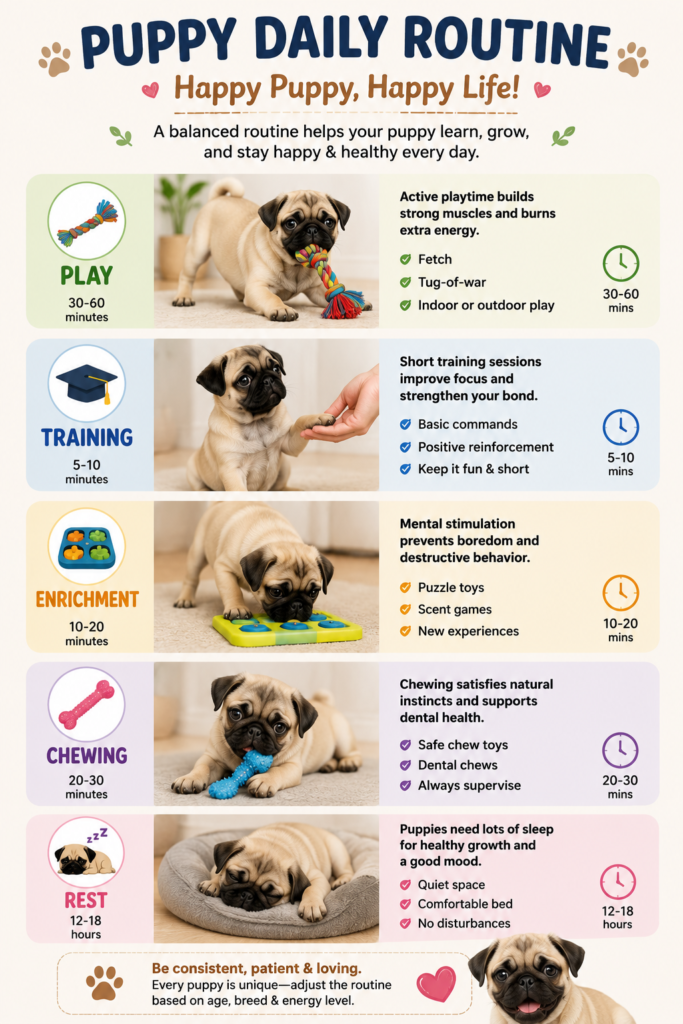
A Simple Daily Routine for a Chewing Puppy
If Puppy Biting Everything seems to happen randomly throughout the day, create predictable opportunities for activity, rest and chewing.
A simple routine might look like this:
| Time | Activity |
|---|---|
| Morning | Toilet break + short training |
| Morning | Breakfast + enrichment toy |
| Midday | Nap/rest |
| Afternoon | Play + supervised chewing |
| Afternoon | Short training session |
| Evening | Walk or age-appropriate activity |
| Evening | Calm chew toy |
| Night | Quiet rest |
The exact schedule should be adjusted according to your puppy’s age, breed, health, energy level and household routine.
Don’t try to keep a puppy constantly active.
Puppies also need plenty of sleep and quiet time. The AKC notes that young puppies commonly sleep for long periods throughout the day.
An overtired puppy can sometimes look like a puppy with endless energy.
What NOT to Do When Your Puppy Chews Something Wrong
When Puppy Biting Everything pushes you to your limit, avoid these common reactions.
Don’t hit or physically punish your puppy
Punishment can damage trust and doesn’t teach the puppy what they should chew instead.
Don’t chase your puppy around the house
You may accidentally create a game of keep-away.
Don’t punish after discovering old damage
Your puppy may not connect your reaction with the earlier behavior.
Don’t give your puppy unlimited freedom too early
Freedom should increase as your puppy demonstrates better choices.
Don’t provide unsafe objects as “practice”
Old shoes, socks or household objects can confuse the puppy about which similar objects are allowed.
If an old shoe is okay, why isn’t your new shoe okay?
From the puppy’s perspective, that distinction may not exist.
When Should You Get Professional Help?
Most puppy chewing improves with maturity, supervision, appropriate enrichment and consistent training.
But Puppy Biting Everything deserves professional attention when the behavior is unusually intense, dangerous, compulsive or connected to other concerning signs.
Consider speaking with a veterinarian or qualified behavior professional if your puppy:
- Frequently swallows non-food objects
- Damages themselves while chewing
- Shows severe distress when left alone
- Becomes aggressive when you approach an object
- Guards objects intensely
- Shows sudden behavior changes
- Continues severe destructive behavior despite consistent management
The ASPCA recommends seeking qualified professional help for potentially compulsive behavior or situations involving aggression around objects.
If you suspect pain, illness or another medical problem, start with your veterinarian.
The Biggest Mindset Shift for Puppy Owners
Here’s the perspective that changed how I think about puppy chewing:
Don’t ask, “How do I stop my puppy from chewing?”
Ask:
“How do I make the right thing easier to chew than the wrong thing?”
That one change makes training much more practical.
Your puppy doesn’t automatically understand the difference between:
your expensive leather shoe
and
the puppy’s expensive leather-looking chew toy.
Both smell interesting.
Both have an enjoyable texture.
Both are available.
So don’t rely entirely on the puppy making the correct decision.
Change the environment.
Provide better alternatives.
Reward good choices.
Repeat.
That’s how Puppy Biting Everything gradually turns into a puppy who knows what belongs in their mouth.
Quick Comparison: Punishment vs. Better Training
| Approach | What Puppy May Learn |
|---|---|
| Yelling after damage | Human becomes unpredictable |
| Chasing stolen objects | Stealing can become a game |
| Hitting | Fear or avoidance |
| Removing object + no alternative | Puppy still needs something to chew |
| Redirecting to a chew | Appropriate chewing is rewarding |
| Rewarding calm behavior | Calm choices become valuable |
| Puppy-proofing | Fewer opportunities for mistakes |
| Enrichment | Better outlets for energy and curiosity |
Reward-based training doesn’t mean allowing unwanted behavior.
It means setting boundaries while teaching the puppy what you actually want them to do.
A 7-Day Chewing Reset
If Puppy Biting Everything has become a daily headache, try this simple one-week reset.
Day 1: Remove temptation
Clean the floor and puppy-proof the main areas.
Day 2: Create a chew station
Keep several appropriate toys in an easily accessible location.
Day 3: Start redirecting
Every inappropriate chew gets calmly exchanged for an appropriate one.
Day 4: Teach “Drop It”
Practice short sessions using toys and rewards.
Day 5: Add enrichment
Introduce a food puzzle, sniffing game or short training session.
Day 6: Improve supervision
Notice exactly when chewing happens.
After waking?
Before meals?
During play?
When tired?
When alone?
Day 7: Review the pattern
Ask:
What triggers the chewing?
What alternative works best?
When does my puppy struggle most?
This turns random frustration into useful information.
Internal Links
- Potty Training a Puppy in 7 Days: Amazing Tips For Guaranteed Success
- Signs Your Puppy Is Mentally Bored (Not Physically Tired): 15 Hidden Warning Signs
- Why Is My Puppy Eating Mulch and Dirt? 9 Hidden Causes, Serious Risks & Proven Solutions (2026 Guide)
- 15 Powerful Signs Your Puppy Loves You (Don’t Ignore These Hidden Clues)
- 25 Cutest Dog Breeds That Stay Adorable Forever (Avoid These Common Mistakes Before Choosing One)
- 10 Best Slow Feeder Dog Bowls for Fast Eaters (2026): Stop Dangerous Gulping & Improve Digestion
- First 30 Days With a New Puppy: The Ultimate Survival Guide to Avoid Common Mistakes & Raise a Happy Dog
- Best Dog Food for Sensitive Stomach: Vet-Approved Picks That Actually Work in 2026!
Frequently Asked Questions
Why is my puppy biting everything all of a sudden?
Teething is a common reason, but boredom, frustration, excitement, exploration and insufficient enrichment can also contribute. If the behavior appears suddenly or is accompanied by other unusual signs, speak with your veterinarian.
Does chewing mean my puppy is aggressive?
No. Normal puppy chewing and play biting are not automatically signs of aggression. However, intense biting, guarding, fear-related behavior or aggressive responses around objects deserve professional assessment.
Should I punish my puppy for chewing furniture?
No. Punishing after the fact is unlikely to teach the desired behavior. Instead, prevent access, interrupt calmly when possible, redirect to an appropriate chew and reward the correct choice.
How many chew toys should a puppy have?
There isn’t one magic number. A useful approach is to provide several safe options with different textures and rotate them. The right choices depend on your puppy’s age, size and chewing style.
When will my puppy stop chewing everything?
Many puppies become significantly less mouthy as they finish teething and mature, but adult dogs can still enjoy chewing. The AKC notes that the intense puppy chewing phase often decreases as puppies approach adulthood, while appropriate chewing remains a normal behavior.
Can I give my puppy an old shoe to chew?
It’s better not to.
If you allow one shoe, your puppy may struggle to understand why another shoe is forbidden. Give them a clearly different, puppy-safe chew instead.
What if my puppy destroys things only when I’m away?
That pattern deserves closer attention. If destruction happens primarily during separation and is accompanied by barking, whining, pacing or other distress, discuss it with your veterinarian or a qualified behavior professional.
Final Thoughts
Living with a puppy can sometimes feel like living with a tiny, four-legged vacuum cleaner.
They investigate everything.
They grab everything.
They chew everything.
And yes, sometimes Puppy Biting Everything can make you wonder whether your furniture will survive the next six months.
But remember: chewing itself isn’t the enemy.
Your puppy is doing something biologically normal.
Your job is to give that behavior a safe direction.
Start with management.
Provide appropriate chew options.
Use redirection.
Teach “drop it” and “leave it.”
Add mental enrichment.
Protect dangerous objects.
Reward good decisions.
And be consistent.
The biggest improvement usually doesn’t come from finding one magical trick. It comes from hundreds of small moments where your puppy learns:
“This is mine to chew.”
And eventually, that lesson becomes a habit.
If you’re currently dealing with Puppy Biting Everything, don’t measure success by whether your puppy never makes another mistake.
Measure progress by how quickly your puppy can choose the right behavior—and how rarely you need to intervene.
That’s the real goal: not a puppy that never chews, but a puppy that knows what to chew.
Your Next Step
Have you found a chew toy, training technique or enrichment game that actually worked for your puppy?
Share your experience in the comments.
And if this guide helped you, share it with another new puppy parent who is currently wondering why their little dog is trying to remodel the entire house.
For more practical puppy-care and dog-training guides, keep exploring CutePawWorld.
Helpful Research & Expert Resources
- ASPCA — Destructive Chewing — practical guidance on causes, management and redirection.
- American Kennel Club — Puppy Chewing & Training — guidance on safe chewing, supervision, “drop it,” enrichment and training.
- American Kennel Club — Puppy Teething & Nipping — information on teething, appropriate chewing and puppy mouthing.
- AVSAB — Humane Dog Training Position Statement — current professional guidance supporting reward-based training.
Conclusion
If you’re dealing with Puppy Biting Everything, remember that chewing is a normal part of puppy development—not a sign that your puppy is being “bad.” The goal is to guide that natural instinct toward safe and appropriate chew toys.
When Puppy Biting Everything becomes frustrating, focus on prevention, supervision, redirection, enrichment, and consistent reward-based training. Give your puppy fewer opportunities to make mistakes and more opportunities to make the right choice.
With patience, Puppy Biting Everything can gradually become a much easier behavior to manage. Instead of trying to eliminate chewing completely, teach your puppy what is okay to chew and reward those good decisions.
Most importantly, don’t get discouraged if Puppy Biting Everything doesn’t stop overnight. Puppies learn through repetition, and every successful redirection is one more step toward a calmer, better-trained companion.