

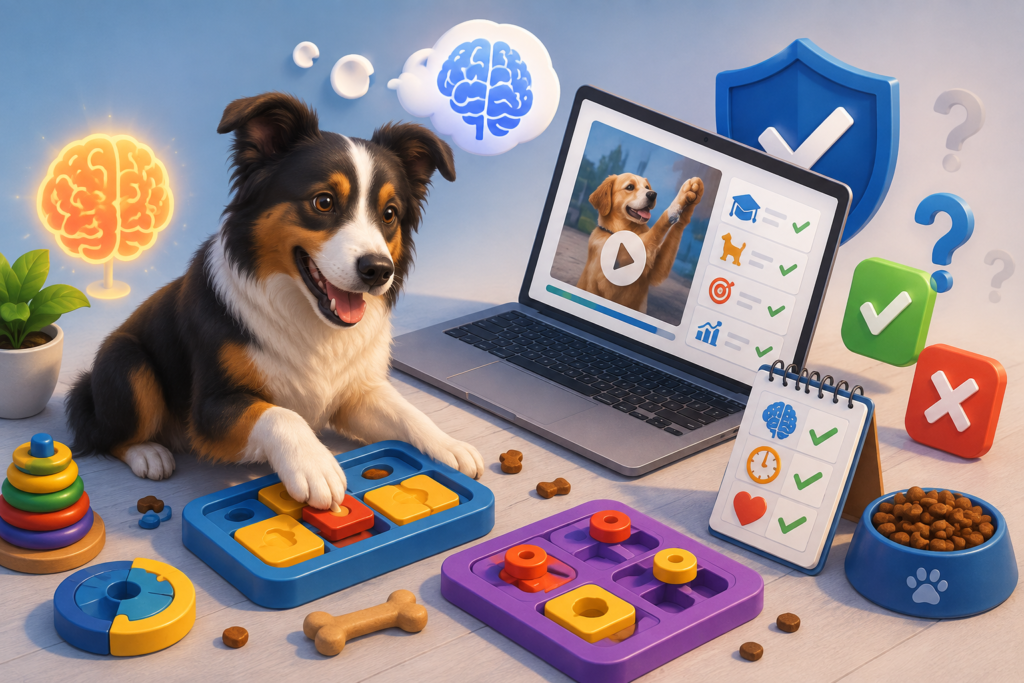
Introduction: Can Training Your Dog’s Brain Actually Change Behavior?
A dog that barks constantly, pulls on the leash, ignores commands, chews furniture, jumps on visitors, or simply seems impossible to tire out can leave an owner wondering what went wrong.
Sometimes the obvious answer seems to be more physical exercise. But dogs need mental stimulation too. The American Kennel Club notes that cognitive games can challenge dogs, provide mental engagement, and help build skills and the relationship between dogs and their owners.
That idea is at the center of Brain Training for Dogs Review 2026. Instead of treating dog training as a long list of commands, the program presents training as a progression of games and mental challenges.
But there is an important distinction between a promising training approach and a guarantee that every behavior problem will disappear.
In this Brain Training for Dogs Review 2026, we will look at what the course actually includes, how its training philosophy compares with modern reward-based guidance, what the strongest benefits may be, and where potential buyers should be cautious.
The goal isn’t to blindly praise the program or automatically dismiss it. It is to determine whether the course makes practical sense for an ordinary dog owner.
What Is Brain Training for Dogs?
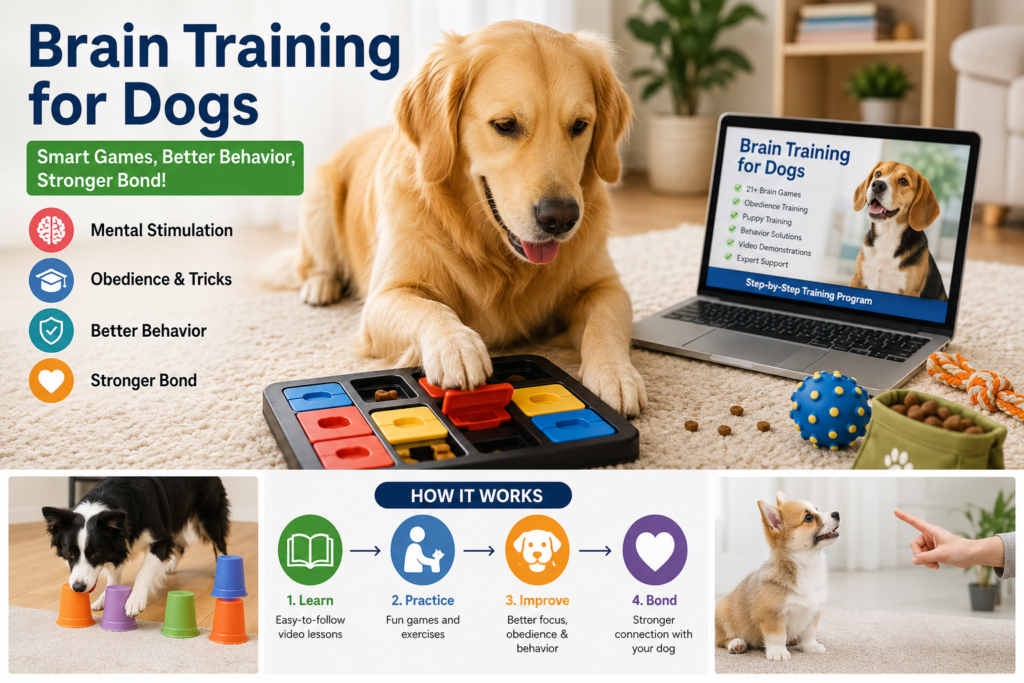
Brain Training for Dogs Review 2026 starts with a relatively simple concept: dogs can benefit from activities that require them to think, concentrate, solve problems, and interact with their owners.
The program was created by Adrienne Farricelli, who identifies herself on the sales page as a CPDT-KA certified professional dog trainer. The program combines brain-training games with obedience exercises and a large collection of behavior-training resources.
According to the current product page, the course contains seven progressive levels, beginning with Preschool and progressing through Elementary School, High School, College, University, Graduation, and finally Einstein.
The structure is interesting because it gives owners a pathway instead of simply handing them a random collection of tricks.
The basic idea is:
Foundation → Mental Games → Impulse Control → Advanced Skills → Tricks
That progression can be particularly useful for owners who don’t know what to teach next.
Affiliate Disclosure: We may earn a commission if you purchase through this link, at no extra cost to you.
How Does Brain Training for Dogs Work?
One of the biggest questions in this Brain Training for Dogs Review 2026 is whether the program is really about making dogs “smarter.”
The marketing language uses terms such as “hidden intelligence” and connects mental stimulation with improved behavior. However, it is better to interpret the concept practically rather than literally.
A training game can encourage a dog to:
- Pay attention to its owner
- Follow a cue
- Solve a simple problem
- Wait for a reward
- Control impulses
- Explore safely
- Repeat successful behaviors
- Build confidence through successful learning
Those are useful training outcomes even without claiming that a dog becomes intellectually transformed.
The American Kennel Club similarly describes brain games as activities that can provide mental stimulation and problem-solving opportunities.
So the strongest argument for the program isn’t necessarily “your dog will become a genius.”
It is that structured mental work can give your dog another way to learn and spend energy.
The Seven Training Levels Explained
A major strength highlighted in this Brain Training for Dogs Review 2026 is the course’s progression system.
1. Preschool
The first level establishes basic attention and targeting skills.
The official course page describes exercises involving targeting, eye contact, and an “airplane game” designed to encourage the dog to focus on the owner.
This foundation matters because a dog that cannot focus is going to struggle with more advanced exercises.
2. Elementary School
The next level introduces more interactive challenges.
The official page lists games such as:
- Treasure Hunt
- Muffin Game
- Ball Pit Game
These exercises are intended to give dogs opportunities to use their senses while staying engaged with an activity.
3. High School
This stage introduces more emphasis on patience and impulse control.
The course page lists:
- Jazz Up and Settle Down
- Bottle Game
- Bobbing for Treats
The “settle down” concept is particularly relevant for owners dealing with over-excitement.
Teaching a dog to transition from excitement to calmness can be much more useful in everyday life than teaching a flashy trick.
4. College
At this level, the program moves toward concentration and motor skills.
Examples listed include:
- Shell Game
- Open Sesame
- Magic Carpet
These exercises create increasingly complicated tasks while maintaining the reward-based structure of the program.
5. University
The next level focuses more on patience, confidence, impulse control, and engagement.
The course includes:
- Hide and Seek
- Look at That
- Hot and Cold
The “Look at That” concept is especially interesting because attention around distractions is an important part of practical dog training.
6. Graduation
At the advanced stage, the course introduces exercises involving movement, recognition, and coordination.
The product page mentions:
- Leg weaving
- Serpentines and spirals
- Name recognition games
These activities can turn basic obedience into more complex interaction.
7. Einstein
The final level is deliberately playful.
The course lists activities such as:
- Tidy Up
- Ring Stackers
- Play the Piano
These aren’t essential obedience skills, but they can give owners fun goals to work toward after foundational training has been established.
What Else Is Included?
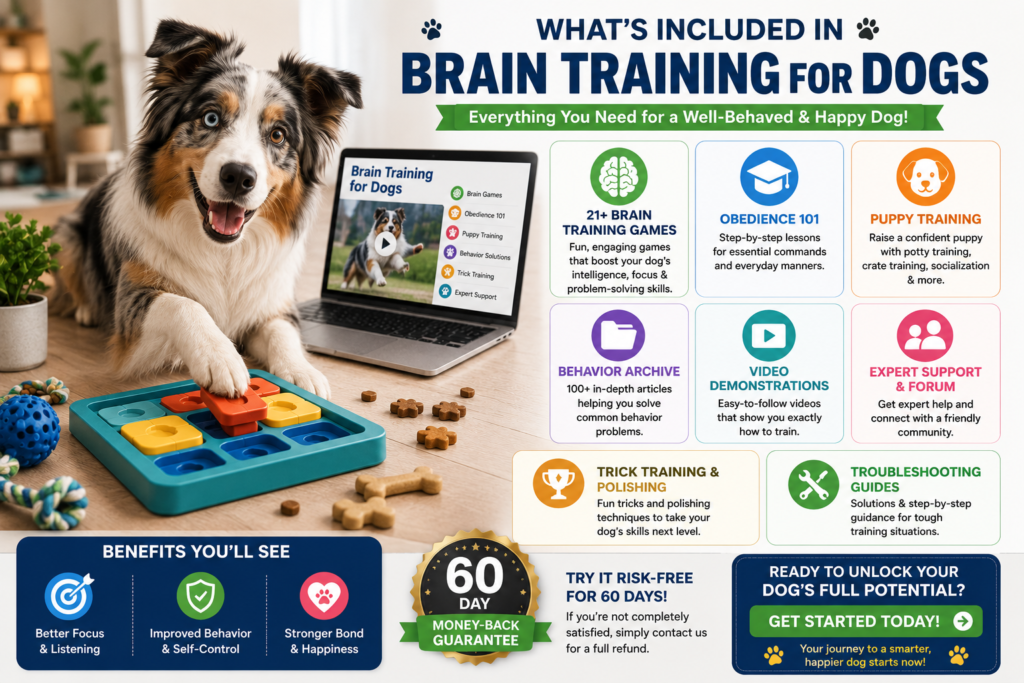
The course is more than the 21+ brain games advertised on the sales page.
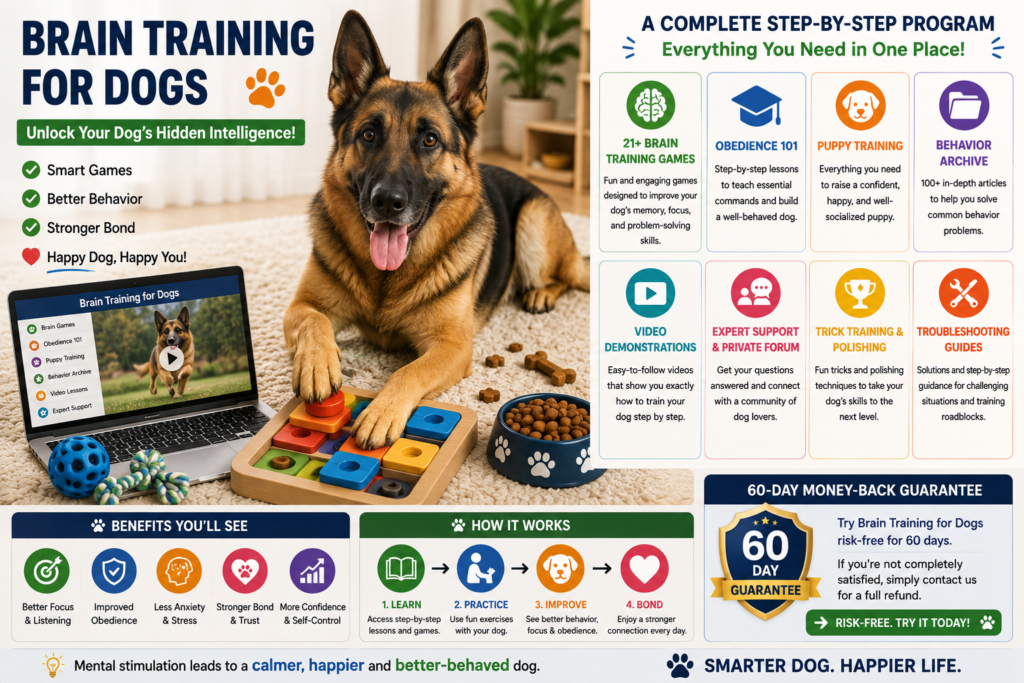
According to the current product information, buyers also receive Obedience 101, additional trick-training videos, polishing techniques, troubleshooting material, a behavior archive, puppy-training resources, video demonstrations, and access to support and a private forum.
That makes the program closer to a general dog-training resource library than a simple puzzle-game collection.
The listed puppy resources include topics such as:
- Potty training
- Crate training
- Socialization
- Bite inhibition
The behavior archive is described as containing more than 100 in-depth articles covering different behavior concerns.
For a first-time dog owner, that breadth may be one of the program’s most useful features.
Why Mental Stimulation Matters
One of the most important insights in this Brain Training for Dogs Review 2026 is that mental exercise should not be confused with physical exercise.
A dog can return from a long walk and still need something interesting to do.
The AKC explains that puzzle activities can provide both physical and mental engagement, while cognitive games can encourage problem-solving.
Scent games are another example. Dogs naturally rely heavily on smell to understand their environment, and scent-based activities can provide meaningful mental stimulation indoors.
This matters because many household behavior problems are made worse when dogs are bored, frustrated, under-stimulated, or lacking appropriate outlets.
That does not mean every barking or destructive behavior is caused by boredom.
But enrichment can be one useful piece of the bigger picture.

Brain Training vs. Traditional Dog Training
A useful comparison in this Brain Training for Dogs Review 2026 is between game-based training and traditional command-focused training.
| Training Approach | Main Focus | Potential Strength |
|---|---|---|
| Basic obedience | Sit, stay, come, heel | Essential everyday control |
| Brain games | Problem-solving and engagement | Mental stimulation |
| Puzzle toys | Independent exploration | Occupies the dog |
| Scent games | Nose work and searching | Natural enrichment |
| Trick training | New behaviors | Bonding and confidence |
| Professional behavior work | Specific behavioral problems | Individualized intervention |
These approaches don’t have to compete.
In fact, the best routine may combine them.
A dog could practice recall, play a scent game, work on impulse control, and finish with a simple trick.
The real question isn’t whether brain games replace obedience.
They don’t.
The better question is whether they complement obedience training.
In that respect, the concept behind this program is sensible.
Is the Training Method Positive?
This is one of the most important sections of this Brain Training for Dogs Review 2026.
The official product page repeatedly describes the program as “force-free” and says it uses gentle training methods and reinforcement of desired behaviors.
That general philosophy aligns with guidance from the American Veterinary Society of Animal Behavior.
AVSAB’s current public position recommends reward-based methods for dog training and behavior modification and advises against aversive methods involving pain, force, or psychological discomfort.
The RSPCA similarly recommends reward-based training and says dogs should be rewarded when they display desired behaviors.
That is a meaningful positive.
However, buyers should still evaluate individual instructions carefully and understand that serious behavior cases may require professional assessment.
What Results Can You Reasonably Expect?
This is where this Brain Training for Dogs Review 2026 needs to be realistic.
The sales page contains strong claims about correcting barking, chewing, jumping, reactivity, and other behaviors. It also includes testimonials from dog owners describing improvements.
Those testimonials may be useful for understanding how some customers experienced the program, but they should not be treated as controlled scientific evidence that every dog will achieve the same outcome.
A more realistic expectation is:
Consistent training + appropriate rewards + repetition + management + patience = better odds of improvement.
Your dog’s:
- Age
- Breed
- Temperament
- Previous training
- Environment
- Motivation
- Health
- Learning history
can all influence progress.
Two dogs can receive exactly the same exercise and respond completely differently.
That’s why I would consider the course a training resource, not a guaranteed behavioral cure.
The Most Interesting Benefit: It Gives Owners a System
One overlooked benefit in this Brain Training for Dogs Review 2026 is not actually about the dog.
It is about the owner.
Many people know they should train their dog but don’t know what to do for the next 10 minutes.
They repeat “sit.”
Then “stay.”
Then they give up.
A structured program solves that organizational problem.
Instead of asking:
“What should I teach my dog today?”
the owner can follow a progression.
That can make training more consistent.
And consistency is incredibly important.
The RSPCA recommends beginning new training in a low-distraction environment and building skills gradually.
A structured program can make that process easier for inexperienced owners.
Benefits, Hidden Downsides, Pricing & Final Verdict
The Biggest Benefits
In this second half of our Brain Training for Dogs Review 2026, let’s separate the practical benefits from the marketing claims.
1. A Large Variety of Exercises
The program gives owners many different activities instead of relying on one training method.
That variety can prevent sessions from becoming repetitive.
2. Progressive Difficulty
The seven-level structure gives owners a logical progression.
A beginner can start with attention and targeting before attempting more advanced challenges.
3. Mental Enrichment
The games can provide an alternative to simply throwing a ball or taking another walk.
This is particularly useful when outdoor exercise is limited.
4. Obedience Training
The program doesn’t focus exclusively on tricks.
It also includes material covering commands such as sit, lie down, stay, heel, come, and drop it.
5. Puppy Resources
New puppy owners may appreciate having training information and behavioral resources in one place.
6. Troubleshooting Material
The course says it includes troubleshooting sections for difficult dogs.
That can be valuable because training rarely goes perfectly on the first attempt.
7. Video Demonstrations
Visual demonstrations can be easier to follow than written instructions alone.
8. Owner Confidence
A structured plan can make an inexperienced owner feel less lost.
That may indirectly improve the dog’s training because the owner is more likely to practice consistently.
Hidden Downsides You Should Know
Every honest Brain Training for Dogs Review 2026 should discuss the negatives.
The program has several potential limitations.
Downside #1: It Requires Owner Participation
Buying a course doesn’t train the dog.
The owner has to:
- Learn the exercises
- Prepare rewards
- Practice consistently
- Observe the dog’s response
- Adjust difficulty
- Repeat behaviors
- Avoid confusing signals
If someone expects the course to produce results without regular practice, disappointment is likely.
Downside #2: Not Every Dog Learns at the Same Speed
The course is presented as a progression, but real dogs don’t necessarily follow a perfect seven-stage timeline.
One dog may master an exercise quickly.
Another may need days or weeks.
The owner should be comfortable moving backward when necessary.
Downside #3: Serious Behavior Problems Need Extra Care
This is probably the most important limitation.
A general online course should not be treated as a substitute for professional assessment when a dog has serious aggression, severe fear, dangerous reactivity, or other potentially unsafe behavior.
The RSPCA recommends seeking veterinary or qualified behavior support for serious behavioral concerns.
A training program can be helpful, but some cases require individualized evaluation.
Downside #4: Marketing Claims Are Strong
The sales page uses very confident language about eliminating problem behavior and improving intelligence.
That doesn’t automatically make the program bad.
But consumers should distinguish between:
“This method may help.”
and
“This method will fix your dog’s problem.”
Those are very different claims.
Downside #5: Some Games Require Preparation
Certain activities involve household objects, treats, or specific setups.
That means the program isn’t always completely hands-off.
For some owners, creating games will be enjoyable.
For others, it may feel like extra work.
What About the Price?
According to the current sales page, the program is advertised at a promotional price of $67, reduced from a displayed $127 price.
Because online offers can change, check the current checkout page before publishing a fixed price in your article.
At $67, the value question becomes interesting.
If you were looking only for a handful of simple dog games, you could find plenty of free ideas online.
The AKC, for example, publishes numerous free training-game and brain-game resources.
So the value of this paid program isn’t necessarily that it contains ideas that cannot be found anywhere else.
Its potential value is organization.
You’re paying for a structured system, progressive exercises, demonstrations, behavior resources, and a centralized training library.
What About the 60-Day Guarantee?
Another important point in this Brain Training for Dogs Review 2026 is the money-back guarantee.
The current sales page states that the purchase comes with a 60-day money-back guarantee and says customers can request a refund if they are not satisfied.
That lowers the financial risk compared with a non-refundable purchase.
Still, consumers should read the current checkout terms and refund instructions before purchasing because policies can change.
A guarantee is useful, but it shouldn’t be interpreted as proof that the training program is scientifically guaranteed to work for every dog.
Brain Training for Dogs vs. Free Resources
Here is perhaps the fairest comparison in this Brain Training for Dogs Review 2026.
| Factor | Brain Training for Dogs | Free Online Resources |
|---|---|---|
| Structured progression | Yes | Usually scattered |
| Brain games | 21+ listed | Many available |
| Obedience material | Yes | Widely available |
| Puppy resources | Yes | Widely available |
| Behavior archive | Yes | Available across many sites |
| Video demonstrations | Yes | Common online |
| Centralized system | Strong | Usually weak |
| Cost | Paid | Often free |
| Professional support | Included according to sales page | Usually unavailable |
| Best for | Owners wanting structure | DIY learners |
This comparison reveals something important.
The paid program isn’t necessarily selling secret information.
It is selling convenience, structure, and organization.
For some dog owners, that is worth paying for.
For others, free resources may be enough.
Can You Get Similar Benefits Without Buying the Course?
Absolutely.
This is an important part of an honest Brain Training for Dogs Review 2026.
You can create a simple mental-enrichment routine at home using safe activities.
For example:
Game 1: Hide-and-Seek
Ask your dog to stay, hide somewhere easy, then call your dog.
Reward the dog enthusiastically when they find you.
Game 2: Treat Search
Hide small pieces of food in safe locations and encourage your dog to sniff them out.
Game 3: Name Recognition
Place two familiar toys in front of your dog and reward them for selecting the named toy.
Game 4: Settle Training
After a short play session, reward calm behavior.
Game 5: Simple Puzzle
Use an appropriate puzzle toy or a safe homemade enrichment activity under supervision.
The AKC provides numerous examples of cognitive games, puzzle activities, scent games, and training exercises that owners can use for mental enrichment.
So why buy a course?
The answer is simple:
Some people don’t need more information. They need a system.
A Better Way to Measure Results
Instead of asking whether your dog suddenly becomes “genius-level,” this Brain Training for Dogs Review 2026 recommends tracking practical changes.
For example, record:
Week 1
- How long can your dog focus?
- How quickly does your dog respond to their name?
- Can your dog sit around mild distractions?
- How quickly does your dog settle after play?
Week 4
Ask the same questions.
This gives you a more meaningful measurement than simply saying, “My dog seems smarter.”
You can even record short videos.
A before-and-after comparison can reveal improvements that are difficult to notice day-to-day.
What Kind of Owner Is This Course Best For?
This Brain Training for Dogs Review 2026 suggests the program may be most suitable for:
- First-time dog owners
- Puppy owners
- Owners who enjoy training games
- Dogs that need additional mental stimulation
- Owners who want a structured curriculum
- People who prefer learning from videos
- People who want obedience and enrichment in one resource
- Owners who need ideas for keeping training interesting
It may be less suitable for someone who wants a trainer to physically work with their dog.
An online course requires active participation.
Who Should Think Twice?
The program may not be the right standalone solution for:
- Severe aggression
- Serious bite risk
- Complex fear disorders
- Severe separation-related problems
- Dangerous reactivity
- Medical conditions affecting behavior
- Cases where safety is an immediate concern
In those situations, professional veterinary or behavior guidance should take priority.
Reward-based training is strongly supported by veterinary behavior organizations, but serious cases still require individualized assessment.
Is Brain Training for Dogs Legit?
The question “Is Brain Training for Dogs legit?” deserves a nuanced answer.
The program is presented as an established online dog-training course created by Adrienne Farricelli, who identifies herself as a CPDT-KA certified trainer. The official page provides substantial information about the curriculum, exercises, resources, support, and refund policy.
The training philosophy described on the sales page also broadly aligns with modern reward-based training recommendations from AVSAB and the RSPCA.
However, legitimacy and guaranteed effectiveness are different questions.
A legitimate product can still produce different results for different dogs.
Therefore, I would classify it as a structured online dog-training resource, rather than promising that it will automatically solve every behavioral problem.
Our Honest Take
After looking at the curriculum and comparing its philosophy with established reward-based training guidance, the most convincing part of this Brain Training for Dogs Review 2026 is not the “hidden intelligence” marketing.
It is the practical combination of mental games + obedience + progression + owner participation.
That combination makes sense.
Dogs benefit from mental engagement.
Training can improve communication between dogs and owners.
Games can make practice more enjoyable.
And positive reinforcement is consistent with current veterinary behavior recommendations.
The biggest caution is the strength of the sales language.
No responsible review should promise that a particular online course will eliminate every behavior problem.
Dogs are individuals.
Training takes time.
And serious behavior problems may require professional help.
Pros and Cons at a Glance
Pros
- Structured seven-level system
- 21+ brain-training games
- Obedience training included
- Puppy-training resources
- Behavior archive
- Video demonstrations
- Troubleshooting material
- Reward-based/force-free approach described by the seller
- Online member area
- Support system and private forum listed
- 60-day money-back guarantee stated on the current sales page
Cons
- Requires consistent owner participation
- Not every dog will progress at the same speed
- Many basic training concepts are available for free
- Strong marketing claims should be interpreted carefully
- Serious behavioral problems may require professional intervention
- Some exercises require preparation and supervision
Frequently Asked Questions
Is Brain Training for Dogs worth it?
In this Brain Training for Dogs Review 2026, our answer is: it can be worth considering if you value a structured curriculum and want many training games in one place.
If you’re comfortable researching free resources and creating your own routine, you may not need a paid course.
Does Brain Training for Dogs really work?
The course contains practical training games and obedience exercises, and its reward-based philosophy aligns with major animal-behavior guidance. However, individual results will vary, and seller testimonials should not be interpreted as universal proof of effectiveness.
Is Brain Training for Dogs good for puppies?
The official program includes a dedicated puppy section covering topics such as potty training, crate training, socialization, and bite inhibition.
Can brain games replace physical exercise?
No.
Mental enrichment complements physical exercise; it shouldn’t automatically replace age-appropriate walks, play, movement, and other physical needs.
Can brain training stop barking?
Brain games may help provide enrichment and teach alternative behaviors, but barking can have many causes.
If barking is related to fear, anxiety, territorial behavior, frustration, or another serious issue, the underlying cause needs to be addressed.
Is the program suitable for older dogs?
Mental enrichment can be useful for dogs of different ages, but exercises should be adapted to the dog’s physical abilities and health.
Is the training force-free?
The current product page states that its methods are force-free and gentle.
That philosophy is consistent with AVSAB’s recommendation to use reward-based methods for canine training.
How much does Brain Training for Dogs cost?
The current sales page displays a promotional price of $67, reduced from a displayed $127 price. Because offers can change, verify the live checkout price before purchasing.
Does it come with a refund guarantee?
The current sales page states that the program includes a 60-day money-back guarantee.
Final Verdict: Is Brain Training for Dogs Worth Trying?
After researching the course for this Brain Training for Dogs Review 2026, I would describe it as an interesting option for owners who want a structured, game-based approach to dog training.
Its biggest strength is organization. Instead of searching dozens of websites, owners get brain games, obedience lessons, puppy resources, behavior information, demonstrations, and support in one place. That’s a key advantage highlighted in this Brain Training for Dogs Review 2026.
The mental-stimulation concept is also reasonable. The American Kennel Club recognizes cognitive games, puzzle activities, scent work, and training games as useful ways to engage dogs mentally. This supports one of the main ideas behind this Brain Training for Dogs Review 2026.
The reward-based philosophy is another positive point and broadly aligns with recommendations from AVSAB and the RSPCA. Still, this Brain Training for Dogs Review 2026 comes with an important warning:
Don’t expect an online course to magically fix every behavioral problem.
Training takes consistency, patience, and repetition. Serious behavioral issues may require professional help.
So, is it worth trying?
For owners who want a structured library of brain games and obedience exercises, it may be worth considering. That’s the balanced conclusion of this Brain Training for Dogs Review 2026.
If you already know how to train dogs and are comfortable creating your own enrichment activities, free resources may be enough. But beginners may appreciate the convenience of having everything organized in one place.
The final decision comes down to what you’re actually buying:
Not a magic solution.
A structured training system designed to make learning more engaging.
Overall, this Brain Training for Dogs Review 2026 finds the program potentially useful for owners who value structure, variety, and convenience.
Before purchasing, check the current price, features, and refund terms. This Brain Training for Dogs Review 2026 ultimately recommends viewing the course as a training resource—not a guaranteed cure.
For owners looking for an organized approach, this Brain Training for Dogs Review 2026 offers a compelling option to consider.
Final takeaway: This Brain Training for Dogs Review 2026 suggests the course may be a worthwhile choice for owners ready to activel
Internal Links
Brain Training for Dogs Review 2026
- Potty Training a Puppy in 7 Days: Amazing Tips For Guaranteed Success
- Signs Your Puppy Is Mentally Bored (Not Physically Tired): 15 Hidden Warning Signs
- 15 Powerful Signs Your Puppy Loves You (Don’t Ignore These Hidden Clues)
- 25 Cutest Dog Breeds That Stay Adorable Forever (Avoid These Common Mistakes Before Choosing One)
- 10 Best Slow Feeder Dog Bowls for Fast Eaters (2026): Stop Dangerous Gulping & Improve Digestion
- First 30 Days With a New Puppy: The Ultimate Survival Guide to Avoid Common Mistakes & Raise a Happy Dog
- Best Dog Food for Sensitive Stomach: Vet-Approved Picks That Actually Work in 2026!
- Puppy Biting Everything? 10 Proven Ways to Stop Destructive Chewing
Ready to Explore Brain Training for Dogs?
If you’ve been struggling to keep your dog mentally engaged or simply want a more organized way to train, you can review the current program details, curriculum, pricing, and guarantee before deciding.
👉 Check the Current Brain Training for Dogs Program
Always review the current offer and terms on the checkout page before purchasing.
If you’ve tried Brain Training for Dogs, we’d also love to hear about your experience. Which exercise worked best for your dog? Did your dog enjoy the games? Share your experience in the comments.
Research Sources
- American Kennel Club — cognitive brain games and mental stimulation for dogs.
- American Veterinary Society of Animal Behavior — humane and reward-based dog-training guidance.
- RSPCA — reward-based dog training and choosing an appropriate trainer.
- Brain Training for Dogs — current course curriculum, pricing, resources and guarantee.
Conclusion
Brain Training for Dogs Review 2026 shows that this program can be an interesting option for dog owners looking for structured, game-based training. The Brain Training for Dogs Review 2026 highlights its combination of brain games, obedience lessons, puppy resources, and behavior-training materials.
For owners who want everything organized in one place, the Brain Training for Dogs Review 2026 suggests that the program offers useful convenience. The Brain Training for Dogs Review 2026 also shows that mental stimulation can be a valuable part of a dog’s overall training routine.
At the same time, the Brain Training for Dogs Review 2026 makes it clear that no online course should be viewed as a magic solution. Consistency, patience, and regular practice remain essential. Based on this Brain Training for Dogs Review 2026, results can also vary depending on the individual dog’s age, temperament, training history, and behavior.
Another important takeaway from this Brain Training for Dogs Review 2026 is that serious behavioral problems may require guidance from a qualified professional. The Brain Training for Dogs Review 2026 therefore recommends using the course as a training resource rather than a guaranteed cure.
Overall, the Brain Training for Dogs Review 2026 finds the program worth considering for owners who enjoy interactive training and want a clear progression to follow.
If you’re looking for convenience, variety, and a structured approach, this Brain Training for Dogs Review 2026 gives the course a positive overall impression.
Final Verdict: The Brain Training for Dogs Review 2026 suggests it’s a potentially useful option for owners who are ready to actively train, practice consistently, and make learning fun for their dogs.