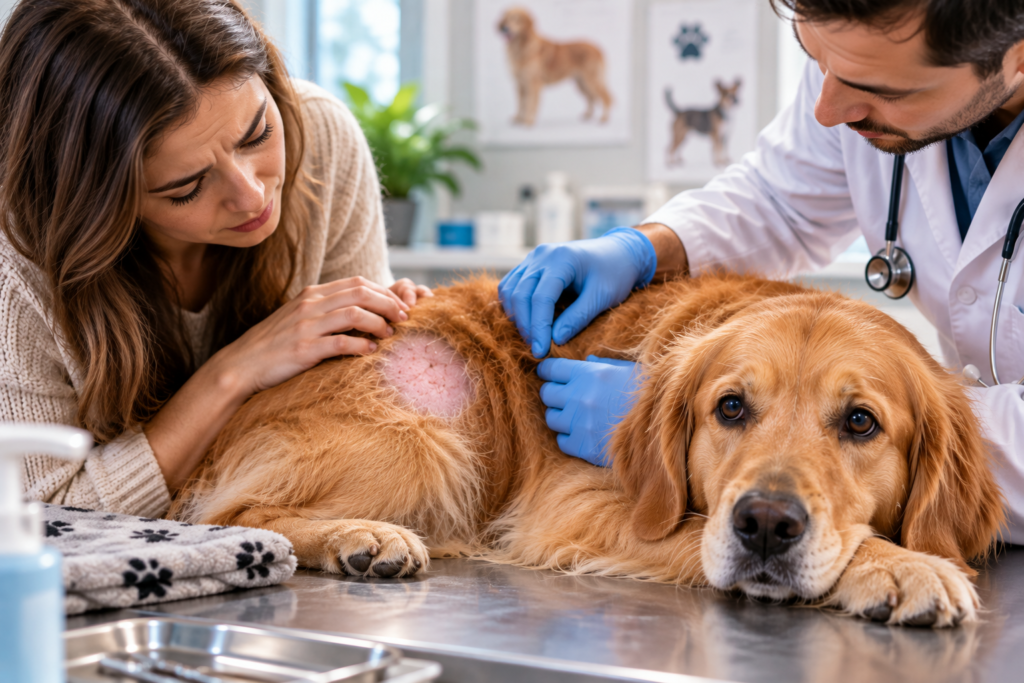

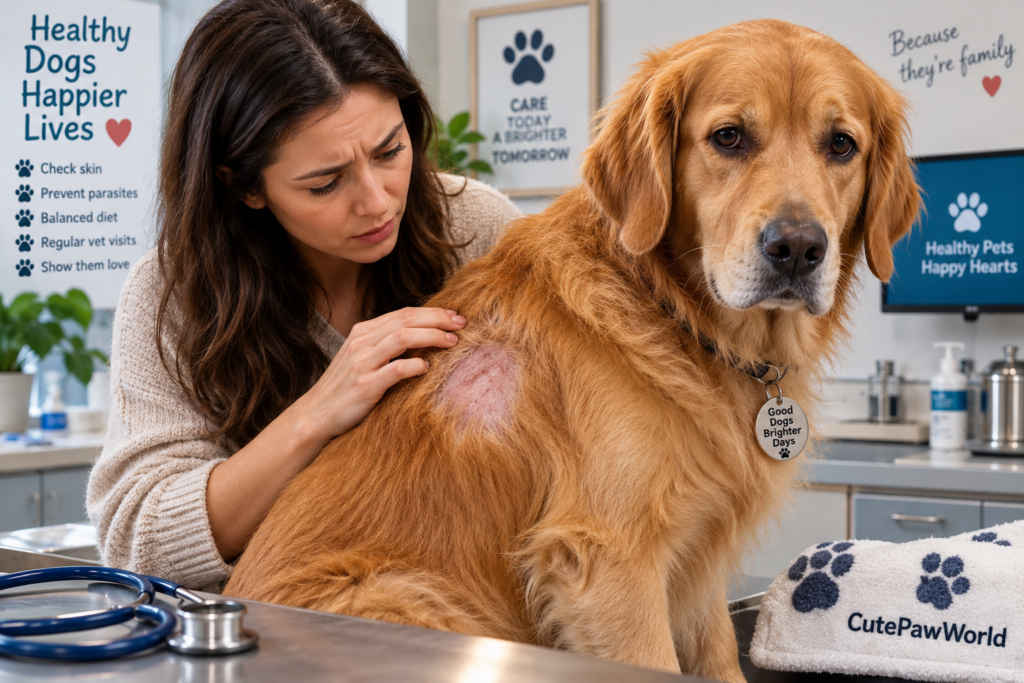
Why Is My Dog Losing Hair in Patches? Golden retriever with a bald patch examined by a veterinarian
Understanding Patchy Hair Loss in Dogs
Imagine running your hand over your dog’s coat one evening and suddenly feeling something different.
You part the fur and see skin.
Maybe it is a small bald circle near the shoulder. Maybe there are several thin patches around the tail, legs, ears, or belly. Your first thought may be simple: Did my dog shed too much?
But Why Is My Dog Losing Hair in Patches is a more complicated question than ordinary shedding.
Dogs naturally lose old hair as new hair grows. However, clearly defined bald spots, thinning areas, broken hairs, redness, crusting, itching, or darkened skin can indicate an underlying skin or systemic problem. Veterinary references classify alopecia—partial or complete hair loss—as a clinical sign rather than a diagnosis by itself.
That distinction matters.
Instead of asking only how to make the hair grow back, you first need to ask why the hair disappeared.
And that is exactly what this guide is designed to explain.
If you have been searching Why Is My Dog Losing Hair in Patches, don’t panic—but don’t automatically ignore it either. Some causes are relatively manageable, while others require veterinary testing and treatment.
What Does Patchy Hair Loss Actually Mean?
Patchy hair loss is often called alopecia.
Alopecia simply means that hair is absent or has been lost from an area where hair would normally grow. It does not tell you the cause.
According to the Merck Veterinary Manual, acquired hair loss can result from problems that damage hair follicles, interfere with hair growth, or cause itching and pain that make the dog scratch, lick, chew, or rub the area.
This explains something many dog owners miss:
The bald patch may not be the original problem.
For example, a dog may develop an itchy skin condition. The dog repeatedly scratches the same location. Eventually, the hair breaks or gets pulled out, leaving a bald patch.
In that situation, the hair loss is a consequence—not the original disease.
So when asking Why Is My Dog Losing Hair in Patches, look beyond the bald spot itself.
Normal Shedding vs. Abnormal Hair Loss
Not every increase in loose fur means something is wrong.
Normal shedding usually produces loose hairs throughout the coat without clearly defined bald areas.
Abnormal hair loss is more concerning when you notice:
- Clearly visible bald patches
- Circular areas of missing hair
- Red or inflamed skin
- Crusts or scabs
- Scaling or dandruff
- Excessive scratching
- Constant licking or chewing
- Darkened or thickened skin
- A strong skin odor
- Pus or discharge
- Hair that breaks rather than naturally sheds
- Hair loss that keeps spreading
Merck notes that excessive shedding becomes more concerning when it produces obvious bald spots or abnormal symmetrical hair loss.
So, Why Is My Dog Losing Hair in Patches should be treated differently from the question, “Why is my dog shedding more than usual?”
Quick Comparison: What the Pattern May Suggest
| What You Notice | Possible Clue | What to Do |
|---|---|---|
| Bald patch + intense itching | Parasites or allergy | Veterinary evaluation |
| Circular bald spots + scaling | Possible fungal infection | Get tested |
| Hair loss around tail and hindquarters | Flea allergy is possible | Check parasite control |
| Symmetrical hair thinning | Hormonal or inherited condition | Veterinary assessment |
| Hair loss + redness/crusting | Infection or inflammation | Veterinary evaluation |
| Bald spot where collar rubs | Friction/trauma | Check equipment |
| Hair loss + lethargy/weight changes | Possible systemic disease | Veterinary visit |
| Hair loss without itching | Hormonal/inherited causes possible | Examination and testing |
| Sudden widespread shedding after illness | Temporary post-illness hair loss possible | Discuss with vet |
This table is not a diagnostic tool. Several diseases can produce similar patterns, and veterinary dermatology often relies on examination and targeted testing to distinguish them.
9 Alarming Causes of Patchy Hair Loss in Dogs
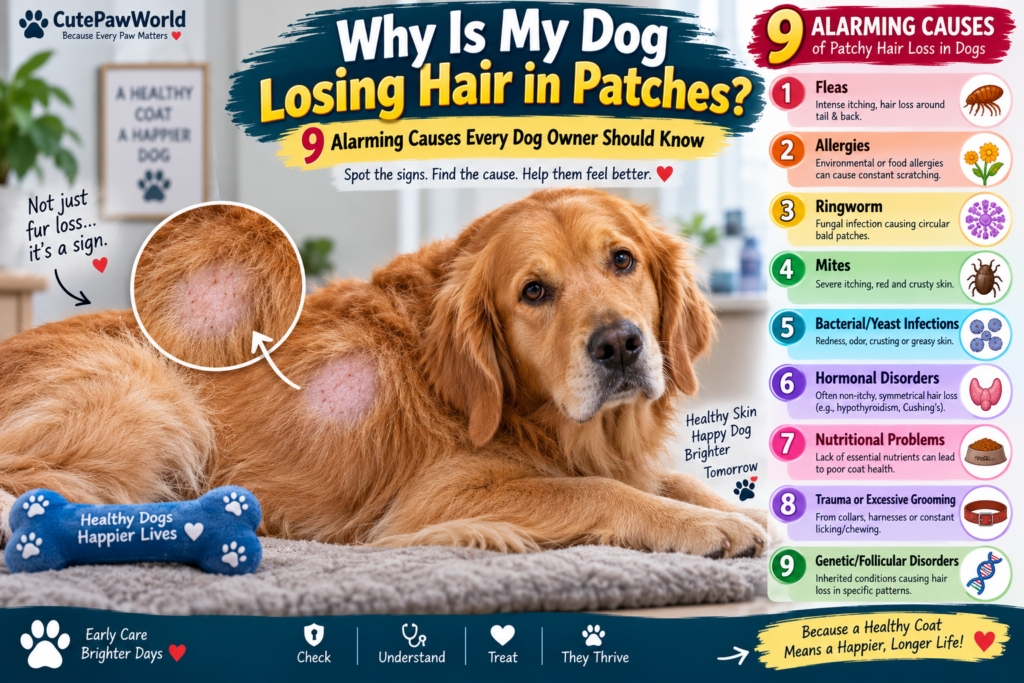
1. Fleas and Flea Allergy Dermatitis
One of the first possibilities to consider is flea-related skin disease.
And here’s the frustrating part: you may not see fleas.
A dog can react strongly to flea bites, and even a relatively small infestation may trigger intense itching in a sensitive dog.
Cornell University College of Veterinary Medicine describes fleas as the most common external parasite of dogs and notes that they can cause intense itching, hair loss, and secondary skin infections.
Merck describes a characteristic distribution for flea allergy dermatitis, commonly involving the mid-to-lower back, tail base, and back of the thighs. Hair loss may occur because the dog scratches, licks, or chews the irritated areas.
This is one reason Why Is My Dog Losing Hair in Patches may not have an obvious answer when you inspect the coat.
Look for:
- Frequent scratching
- Chewing around the tail
- Red bumps
- Hair thinning near the rump
- Darkened skin in chronic cases
- Excessive licking
Another important point is that flea control involves more than simply removing visible fleas from the dog. Fleas have multiple life stages, and much of the population can exist in the surrounding environment.
Do not automatically apply multiple flea products at once. Ask your veterinarian which parasite-control product is appropriate for your dog’s age, weight, species, and health status.
2. Allergies
Allergies can make dogs incredibly itchy.
And once itching starts, hair loss may follow.
Dogs can develop allergic skin disease associated with environmental allergens, food, flea bites, or other triggers.
Cornell notes that excessive itchiness is a major sign of canine atopic dermatitis. Dogs may scratch, lick their feet, rub their faces, and eventually develop hair loss in the areas they repeatedly traumatize.
That means Why Is My Dog Losing Hair in Patches can sometimes really mean:
“Why is my dog repeatedly attacking the same area of skin?”
Pay attention to the behavior surrounding the hair loss.
If your dog is:
- Licking paws constantly
- Scratching the ears
- Rubbing the face
- Chewing the legs
- Scooting
- Scratching the belly
- Developing brown staining around frequently licked areas
then an allergic or inflammatory skin problem becomes more plausible.
Chronic inflammation can also cause the skin to become darker and thicker, while secondary infections may develop.
3. Ringworm and Other Fungal Skin Infections
The name is misleading.
Ringworm is not caused by a worm.
It is a fungal infection that can affect the skin and hair.
The CDC explains that ringworm can spread between people, pets, objects, and contaminated surfaces. It can also affect hair and produce hair loss.
Dogs with dermatophytosis may develop:
- Circular or irregular areas of hair loss
- Scaling
- Crusting
- Broken hairs
- Mild to significant inflammation
However, the appearance alone cannot reliably confirm ringworm.
This is an important point for anyone searching Why Is My Dog Losing Hair in Patches because many different skin diseases can create round or irregular bald spots.
If a fungal infection is suspected, your veterinarian may recommend appropriate testing rather than relying on appearance alone.
And because some dermatophytes can infect people, especially vulnerable household members, suspected cases deserve appropriate veterinary attention and hygiene precautions.
Do not share brushes, bedding, or grooming equipment between pets until an infectious condition has been ruled out or treated.
4. Mites and Other Parasites
Fleas aren’t the only external parasites capable of causing hair loss.
Certain mites can cause significant itching, inflammation, crusting, and hair loss.
Some mite-related conditions can spread between animals, while others are associated with problems involving the dog’s immune system or hair follicles.
This is why simply looking at your dog’s fur is not enough to answer Why Is My Dog Losing Hair in Patches.
A veterinarian may use:
- Skin scrapings
- Hair examination
- Microscopic examination
- Cytology
- Other laboratory tests
depending on the suspected condition.
Merck specifically notes that veterinarians may examine the hair coat and perform skin scrapings to investigate parasites and other causes of alopecia.
If your dog suddenly develops multiple bald patches accompanied by severe itching, don’t assume it is simply dry skin.
5. Bacterial or Yeast Skin Infections
Sometimes the hair loss is connected to an infection.
Bacterial skin disease can cause inflammation, pustules, crusting, odor, discomfort, and hair loss. Yeast overgrowth can also contribute to itching, odor, greasy skin, discoloration, and recurrent skin problems.
Merck explains that bacterial, fungal, and parasitic infections can directly damage hair follicles or cause enough inflammation and discomfort to result in hair loss.
This is where the “smell test” can occasionally provide a useful clue.
If your dog’s skin suddenly develops a noticeably unpleasant odor alongside:
- Bald patches
- Redness
- Greasy skin
- Crusts
- Discharge
- Persistent itching
it deserves veterinary attention.
But odor alone cannot tell you whether the cause is bacterial, yeast-related, allergic, or something else.
The treatment depends on the actual diagnosis.
The Deeper Causes You Shouldn’t Miss

6. Hormonal Disorders
Not every dog with hair loss is itchy.
That distinction can be extremely useful.
Hormonal disorders can produce hair thinning or alopecia with little or no itching, particularly when there is no secondary infection.
One example is hypothyroidism.
Merck notes that hypothyroidism can cause dry skin, excessive shedding, delayed hair regrowth, and usually symmetrical hair thinning or hair loss involving areas such as the trunk, thighs, tail, neck, and nose.
Other signs can include changes in energy, body condition, or other systemic symptoms.
Another endocrine disorder, Cushing disease, can also be associated with hair loss and skin changes.
This is why Why Is My Dog Losing Hair in Patches should not always lead you toward a skin-only solution.
If your dog has hair loss combined with broader changes such as:
- Increased thirst
- Increased urination
- Weight changes
- Reduced energy
- Changes in appetite
- Recurrent skin infections
- A pot-bellied appearance
talk with your veterinarian.
Blood tests and other diagnostics may be appropriate.
7. Nutritional Problems
Hair is made from biological building blocks, so nutrition matters.
Dogs require an appropriate balance of protein, essential nutrients, vitamins, and minerals to maintain normal skin and coat health.
But there is an important misconception here:
Most dogs with patchy hair loss do not automatically need a random “hair supplement.”
Merck lists nutritional deficiencies, particularly protein deficiency, among potential causes of impaired hair growth.
However, supplementing blindly can distract from the actual problem.
For example, if the real cause is fleas, an allergy, infection, or hormonal disease, adding a coat supplement does not address the underlying trigger.
Before changing your dog’s diet or adding concentrated supplements, discuss the situation with a veterinarian.
If you have recently changed food, started a homemade diet, restricted ingredients, or noticed weight loss along with coat changes, mention those details during the appointment.
8. Friction, Trauma, Excessive Grooming, or Self-Trauma
Sometimes the cause is surprisingly mechanical.
A poorly fitted collar or harness can repeatedly rub the same area.
A dog may also injure the skin by excessive scratching, licking, chewing, or rubbing.
Merck specifically lists friction from poorly fitted equipment as a possible cause of localized hair loss.
So when wondering Why Is My Dog Losing Hair in Patches, examine your dog’s daily routine.
Ask:
- Did the bald area appear under a collar?
- Did you recently change harnesses?
- Has your dog been scratching against furniture?
- Is your dog obsessively licking one location?
- Did grooming recently occur?
- Was the coat shaved or clipped unusually short?
A physical trigger can be easy to miss if you’re focused only on medical explanations.
However, don’t assume friction is responsible simply because the bald patch is located near equipment. Persistent hair loss should still be assessed if it doesn’t improve after removing the suspected irritant.
9. Genetic, Follicular, or Immune-Mediated Conditions
The final category is broader but important.
Some dogs develop inherited or breed-associated hair-loss disorders.
Merck describes several hereditary follicular conditions, including color dilution alopecia and other forms of follicular dysplasia. Some breeds are predisposed to particular patterns of hair loss.
There are also conditions in which the immune system is involved.
These cases can be challenging because the dog may not look obviously sick.
The pattern can be:
- Symmetrical
- Gradual
- Non-itchy
- Limited to particular body regions
- Associated with changes in skin pigmentation
Recent veterinary references also describe specific forms of pinnal alopecia affecting the ear flaps, including periodic pinnal alopecia and pattern baldness.
If your dog has had recurrent or progressive hair loss despite appropriate treatment for common causes, a veterinary dermatologist may be helpful.
The Most Important Question: Is Your Dog Itchy?
When investigating Why Is My Dog Losing Hair in Patches, one of the most useful observations you can make at home is whether your dog is itchy.
If your dog IS itchy:
Think more strongly about possibilities such as:
- Fleas
- Flea allergy
- Environmental allergies
- Food allergy
- Mites
- Fungal infection
- Bacterial or yeast-associated skin disease
- Self-trauma
If your dog is NOT itchy:
Your veterinarian may consider possibilities such as:
- Hormonal disorders
- Hereditary hair-loss conditions
- Follicular disorders
- Certain immune-mediated diseases
- Nutritional problems
- Post-illness hair-cycle disturbances
This isn’t a diagnosis. It is simply a useful way to organize the possibilities.
Merck specifically recommends investigating pruritus first when an animal has hair loss and is itchy.
What Does the Shape of the Bald Patch Tell You?
The location and pattern can provide clues.
Circular patches
May occur with fungal disease, but a circular shape does not prove ringworm.
Hair loss around the tail base
Can be particularly suggestive of flea allergy when accompanied by itching.
Symmetrical hair loss
Can occur with endocrine or hereditary disorders.
Ear-edge hair loss
Can have several causes, including hereditary pattern baldness and specific alopecias.
Hair loss with redness and crusts
Raises concern for inflammatory or infectious skin disease.
Hair loss without inflammation
May make some inherited, follicular, or hormonal causes more likely.
Again, the pattern helps create a differential diagnosis—it does not replace testing.
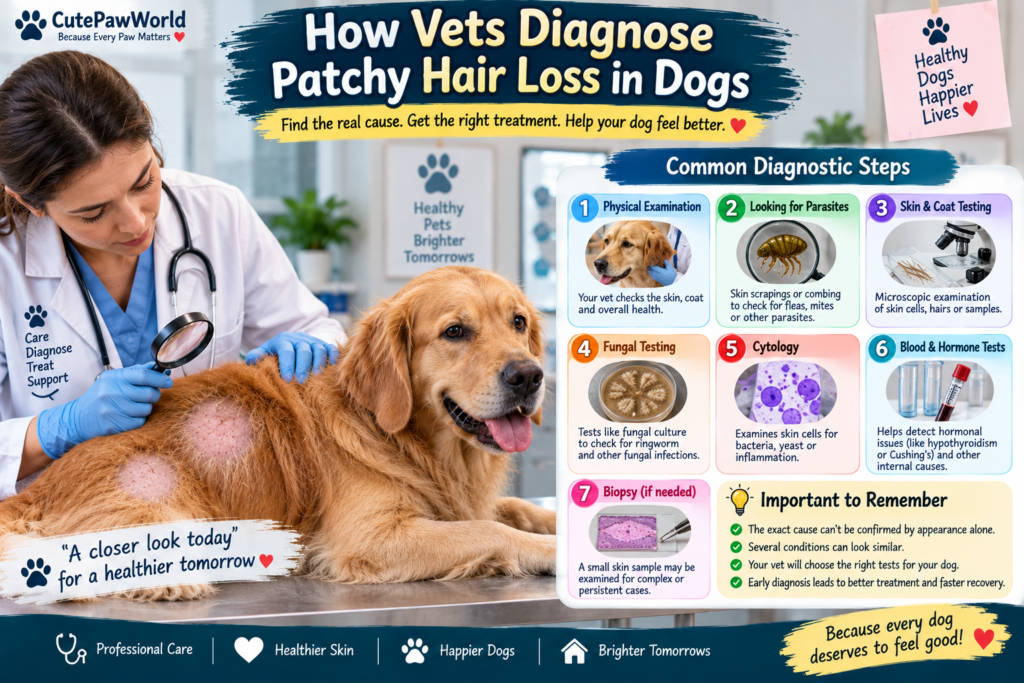
How Veterinarians Diagnose Patchy Hair Loss
One of the biggest mistakes dog owners make is trying five treatments simultaneously before finding the cause.
A veterinarian usually begins with a detailed history and physical examination.
They may ask:
- When did the hair loss start?
- Is it spreading?
- Is the dog itchy?
- Has the dog been scratching?
- What parasite prevention is being used?
- Has there been a food change?
- Are other pets affected?
- Has anyone in the household developed skin lesions?
- Is there weight or appetite change?
- Has the dog had recent illness?
- What medications are being used?
Then the veterinarian may examine the skin and coat closely.
Potential diagnostic tests can include:
- Flea combing
- Skin scraping
- Cytology
- Fungal testing or culture
- Hair examination
- Blood tests
- Urine testing
- Hormonal testing
- Skin biopsy in selected cases
Merck notes that skin scrapings, cultures, laboratory testing, and sometimes biopsy may be needed depending on the suspected cause.
That diagnostic process explains why Why Is My Dog Losing Hair in Patches cannot be answered responsibly from a photograph alone.
When Should You Take Your Dog to the Vet?
Not every tiny bald patch represents an emergency.
But certain signs should move the appointment higher on your priority list.
Contact your veterinarian promptly if the hair loss is:
- Rapidly spreading
- Accompanied by severe itching
- Painful
- Associated with pus or discharge
- Producing a strong odor
- Associated with significant redness or swelling
- Affecting multiple areas
- Accompanied by lethargy or other systemic changes
- Recurrent despite treatment
- Occurring alongside major changes in thirst, urination, appetite, or weight
If your dog seems seriously ill, has extensive skin damage, or is in significant pain, seek veterinary care promptly.
What NOT to Do When Your Dog Loses Hair
When people search Why Is My Dog Losing Hair in Patches, they often encounter dozens of home remedies.
Be careful.
Avoid randomly applying:
- Human steroid creams
- Essential oils
- Strong antiseptics
- Multiple flea products
- Human antifungal medication
- Aggressive shampoos
- Unnecessary supplements
A product that is safe for humans may not be appropriate for dogs.
More importantly, treating the visible bald patch without identifying the underlying cause can delay the correct diagnosis.
Can Dog Hair Grow Back?
Often, yes—but it depends on why it was lost.
If the hair follicle remains healthy and the underlying problem is successfully controlled, regrowth may occur.
But some follicular or inherited conditions can result in persistent or recurrent hair loss.
Merck notes that treatment success depends on identifying and treating the underlying cause.
So the better question isn’t:
“What will make my dog’s hair grow back fastest?”
It is:
“What caused the hair to disappear in the first place?”
Once that question is answered, treatment becomes much more logical.
A Simple At-Home Observation Checklist
Before your veterinary appointment, take clear photos of the affected areas.
Then record:
1. Location
Where exactly is the hair missing?
2. Timeline
When did you first notice it?
3. Progression
Is the area getting larger?
4. Itching
How often is your dog scratching or licking?
5. Skin appearance
Is it red, flaky, dark, thick, wet, crusty, or normal-looking?
6. Other symptoms
Any changes in appetite, energy, thirst, urination, weight, or behavior?
7. Parasite prevention
What product is being used, and when was the last dose?
8. Recent changes
Food, grooming, shampoo, medication, environment, bedding, collar, harness, or household changes?
This information can make the veterinary consultation much more productive.
9 Causes at a Glance
| Cause | Usually Itchy? | Common Clues | Veterinary Testing May Help? |
|---|---|---|---|
| Fleas/Flea allergy | Often | Tail base, rump, intense scratching | Yes |
| Environmental/food allergy | Often | Licking, scratching, recurrent inflammation | Yes |
| Fungal infection | Variable | Scaling, broken hairs, patches | Yes |
| Mites | Often | Itching, crusting, inflammation | Yes |
| Bacterial/yeast disease | Often | Odor, redness, crusting | Yes |
| Hypothyroidism | Usually not initially | Symmetrical thinning, coat changes | Yes |
| Other hormonal disease | Often not | Systemic signs + coat changes | Yes |
| Trauma/friction | Variable | Localized area | Sometimes |
| Genetic/follicular disease | Often not | Patterned or progressive hair loss | Sometimes |
The table summarizes broad patterns only. Individual dogs can present differently, and several conditions can occur at the same time.
Fresh Perspective: Don’t Treat the Bald Spot—Find the Story Behind It
One of the most useful ways to think about Why Is My Dog Losing Hair in Patches is to imagine the bald patch as a message.
The skin is telling you that something has changed.
Sometimes the message is:
“Something is biting me.”
Sometimes it is:
“Something is making me itchy.”
Sometimes:
“My hair follicles aren’t functioning normally.”
And occasionally:
“There is a problem elsewhere in my body.”
That is why two dogs can have almost identical bald spots but completely different diagnoses.
A flea-allergic dog and a dog with a hormonal disorder can both lose hair—but the underlying biology is completely different.
The visual appearance gets your attention.
The diagnostic process tells you the story.
Internal Links
- 10 Best Slow Feeder Dog Bowls for Fast Eaters (2026): Stop Dangerous Gulping & Improve Digestion
- First 30 Days With a New Puppy: The Ultimate Survival Guide to Avoid Common Mistakes & Raise a Happy Dog
- Best Dog Food for Sensitive Stomach: Vet-Approved Picks That Actually Work in 2026!
- Puppy Biting Everything? 10 Proven Ways to Stop Destructive Chewing
- Brain Training for Dogs Review 2026: Honest Results, Powerful Benefits & Hidden Downsides
- Why Do Dogs Kick After Pooping? The Surprising Truth Every Dog Owner Should Know
- 7 Shocking Things Dogs Know About You That You Never Realized
Frequently Asked Questions
Why Is My Dog Losing Hair in Patches but Not Itching?
Hair loss without obvious itching can occur with hormonal, hereditary, follicular, or other non-inflammatory conditions. However, lack of visible scratching does not rule out every skin disease. A veterinarian can help distinguish among the possibilities.
Why Is My Dog Losing Hair in Patches Around the Tail?
Hair loss around the tail base and hindquarters is commonly associated with flea allergy dermatitis, particularly when intense itching is present.
Why Is My Dog Losing Hair in Patches on Its Ears?
Several conditions can affect the ears, including inherited pattern baldness and specific forms of pinnal alopecia. Veterinary examination is useful when the loss is sudden, progressive, inflamed, or recurrent.
Why Is My Dog Losing Hair in Patches After Being Sick?
Temporary hair loss can occur after certain severe illnesses or periods of physiological stress. The timing and overall health history are important when determining whether this is the explanation.
Can allergies cause bald spots in dogs?
Yes. Allergic skin disease can lead to intense itching, licking, chewing, and scratching, which can ultimately produce hair loss.
Can fleas cause bald spots even if I don’t see fleas?
Yes. Fleas can be difficult to spot, and flea allergy can cause significant itching and hair loss. Cornell notes that fleas are common external parasites and that their life cycle includes stages in the surrounding environment.
Is patchy hair loss always serious?
No. Some causes are relatively manageable, while others require investigation and treatment. The important point is that alopecia is a sign, not a diagnosis.
Final Thoughts: Don’t Ignore the Pattern
If you came here asking Why Is My Dog Losing Hair in Patches, the most important takeaway is simple:
Patchy hair loss is a symptom, not a single disease.
Fleas, allergies, fungal infections, mites, bacterial or yeast-related skin disease, hormonal disorders, nutritional problems, physical irritation, and inherited follicular conditions can all play a role.
The good news is that identifying the pattern early can make the next step much clearer.
Take photos.
Watch for itching.
Check for changes in the skin.
Think about recent changes in food, grooming, medications, parasite prevention, or environment.
And if the bald spots are spreading, inflamed, painful, infected-looking, or accompanied by other health changes, arrange a veterinary examination rather than experimenting with multiple home remedies.
Remember, Why Is My Dog Losing Hair in Patches is not simply a cosmetic question.
Your dog’s coat can sometimes provide an early clue that something deserves closer attention.
🐾 Share Your Dog’s Story
Has your dog ever developed a mysterious bald patch?
What did it look like, where did it appear, and what did your veterinarian discover?
Share your experience in the comments and help another dog owner recognize the signs early.
And if this guide helped you understand Why Is My Dog Losing Hair in Patches, share it with another dog parent who may be dealing with the same confusing problem.
For more evidence-based dog-care guides, bookmark CutePawWorld and explore our upcoming articles on canine skin, grooming, behavior, nutrition, and everyday health.
Suggested External References
For readers who want deeper medical information, link naturally to:
- Merck Veterinary Manual — Hair Loss (Alopecia) in Dogs
- Merck Veterinary Manual — Dermatological Problems in Animals
- Cornell University — Fleas in Dogs
- Cornell University — Canine Atopic Dermatitis
- CDC — Ringworm: Causes
Important: The article is educational and should not replace an examination by a veterinarian. The exact cause of hair loss requires diagnosis based on the individual dog’s history, examination, and—when needed—testing.

Conclusion: Don’t Ignore Your Dog’s Changing Coat
If you’re wondering Why Is My Dog Losing Hair in Patches, don’t panic—but don’t ignore it either. Patchy hair loss can have many causes, from fleas and allergies to infections, hormonal problems, and genetic conditions.
Understanding Why Is My Dog Losing Hair in Patches requires looking at the bigger picture. Pay attention to itching, redness, scaling, odor, spreading bald spots, and changes in your dog’s behavior or overall health.
If you’re still asking Why Is My Dog Losing Hair in Patches, avoid randomly using home remedies or supplements. The right treatment depends on the underlying cause, and a veterinarian can help identify it through an examination and, when necessary, diagnostic tests.
The good news is that many causes can be managed successfully when identified early. So if you notice yourself asking Why Is My Dog Losing Hair in Patches, take photos, monitor the affected area, and seek veterinary advice if the problem persists or worsens.
If this guide helped you understand Why Is My Dog Losing Hair in Patches, share it with another dog parent. Your dog’s coat can be an important clue to its health—so paying attention early can make a real difference. 🐶❤️